Christy Hovanetz, Ph.D., is a Senior Policy Fellow for ExcelinEd focusing on school accountability and math policies.

“In the early 1960s Francis Keppel, then U.S. Commissioner of Education, recognized the need for a nation assessment that would provide technically sound and valid data regarding pupils’ knowledge, skills, and abilities… For nearly 100 years reports issued by previous commissioners dealt primarily with summary descriptive statistics of ‘input’ variables in the education system, such as per pupil expenditures, attendance, number of classrooms, teacher salaries, enrollment, and so forth… Only during Keppel’s tenure… (1962-1965) was any attention paid to gathering data on such ‘output’ variables as how much students are learning and what progress is being made [in] U.S. education.”
In 1969, the first national assessments were administered for citizenship (civics), science and writing to 9-, 13- and 17-year-olds. Since then, the assessment, now known as the National Assessment of Educational Progress (NAEP), has been on the leading edge of innovation.
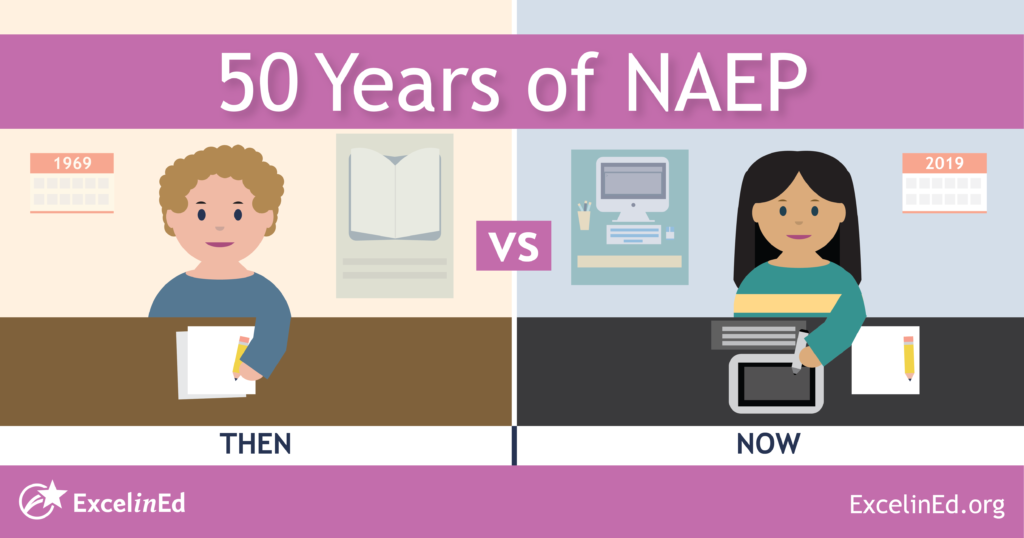
Within the last 50 years, NAEP has gone from developing paper-and-pencil tests to administering scenario-based tasks, interactive computer tasks and hybrid hands-on tasks using real-world, problem-based scenarios that include dynamic texts, videos and animation as well as innovative item types and formats.
In 2017, NAEP mathematics and reading assessments were administered digitally on tablets with an attached keyboard, a stylus and earbuds. The assessment also used new testing methods and item types. NAEP tasks ask students to work through a series of questions to demonstrate what they know and can do, in ways that more accurately reflect what is happening in today’s classrooms. Some items included multimedia, such as audio and video, while others allowed the use of digital tools, like an onscreen calculator, to form a response.
These digital assessments immerse students and challenge them to think critically, evaluate content and solve problems. They also provide for accommodations, allowing universal access to all students, and are more efficient and cost effective.
NAEP prioritizes maintaining trend lines to compare performance results from one year to another. Through the decades, changes and additions in content and delivery mode have not impacted comparability, given the thorough research design and a careful study of the effects used to establish links across administrations to ensure comparability.
NAEP has come a long way, and the next 50 years will see even more advances and opportunity. Maybe we’ll even find ourselves testing in augmented or virtual reality!
Join the National Assessment Governing Board and the National Center for Education Statistics for NAEP Day on October 30, 2019. The 2019 NAEP Reading and Mathematics results for grades 4 and 8 will be released and they will host a discussion with stakeholders on building more equitable outcomes in education.
