
Sam Duell is the Policy Director for Charter Schools at ExcelinEd.


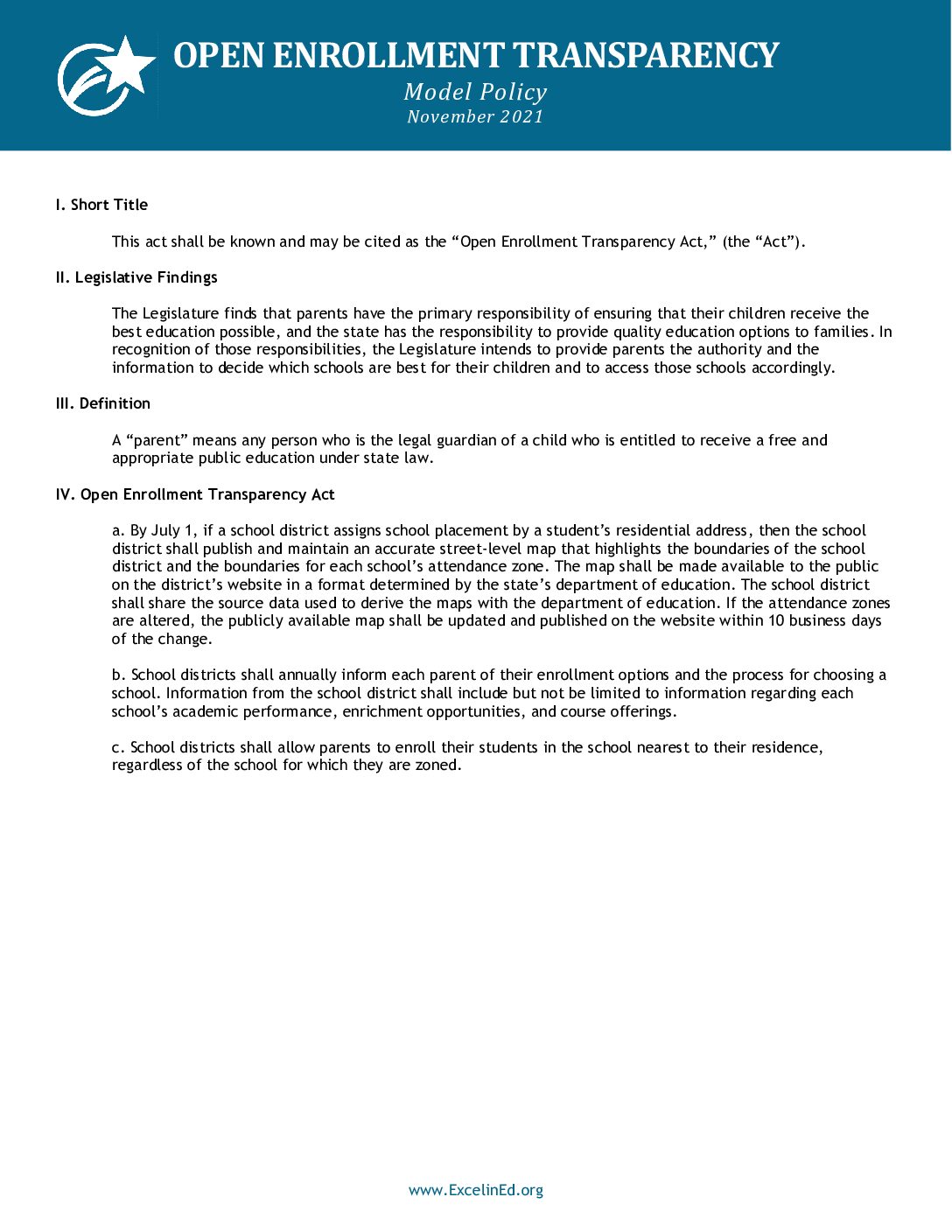
While ten (10) states in our new analysis do require state-level policymakers or districts to inform parents of their options, not one of the twenty (20) states require districts to publish school attendance zone maps. Our new model policy aims to change that by specifically and accurately informing parents of their options and their obstacles. By highlighting this information, we hope parents will be able to advocate effectively for best-fit options. The model policy contains the following objectives:
The adoption of this model policy would be one step in the right direction for many states. Parents have a right to know what their options are and how they access them.
Open enrollment policies clarify how and when parents can access their chosen public schools, regardless of residence. There are two types of open enrollment policies: (1) interdistrict policies determine how parents can access public schools outside their district of residence, and (2) intradistrict policies determine how parents can access any public school within their district of residence.
Mandatory policies require districts to participate, while voluntary policies allow districts to choose to participate. Thirty-four (34) states have intradistrict policies, twenty (20) of those policies are mandatory, while fourteen (14) are voluntary. Some states have both mandatory and voluntary policies. Our analysis compares mandatory intradistrict open enrollment policies in twenty (20) states.
Eight (8) states have broad mandatory intradistrict policies that allow parents to choose a public school for nearly any reason. Nine (9) states limit mandatory intradistrict policies to address specific issues like geography, safety, or low-performing schools. Three (3) states have both broad and specific mandates.
A few states have mandates related to safety, school performance, and geographic location. Eleven (11) states explicitly address transportation in the intradistrict section of statute, and seven (7) states only allow intradistrict transfers during an established window of time.
Check out this analysis to see comparisons regarding broad vs. specific mandates, transportation mandates, and mandates that describe how and when parents should be informed.
