


















Adriana Harrington is the Managing Director of Policy for ExcelinEd.


ExcelinEd has added new state studies and model policies to PathwaysMatter.org, further expanding this comprehensive resource for policymakers who are interested in learning how to strengthen their state’s education to workforce pathways.
The Pathways Matter framework provides 20 key policies in six focus areas that all states can consider leveraging to improve their education to workforce pathways. This framework serves as a comprehensive tool for policymakers to understand state policy strengths and identify gaps that create barriers for learners.
As part of the framework, ExcelinEd has expanded the number of model policies for states to consider. A set of 30 model policies can be accessed on the Pathways Matter site.
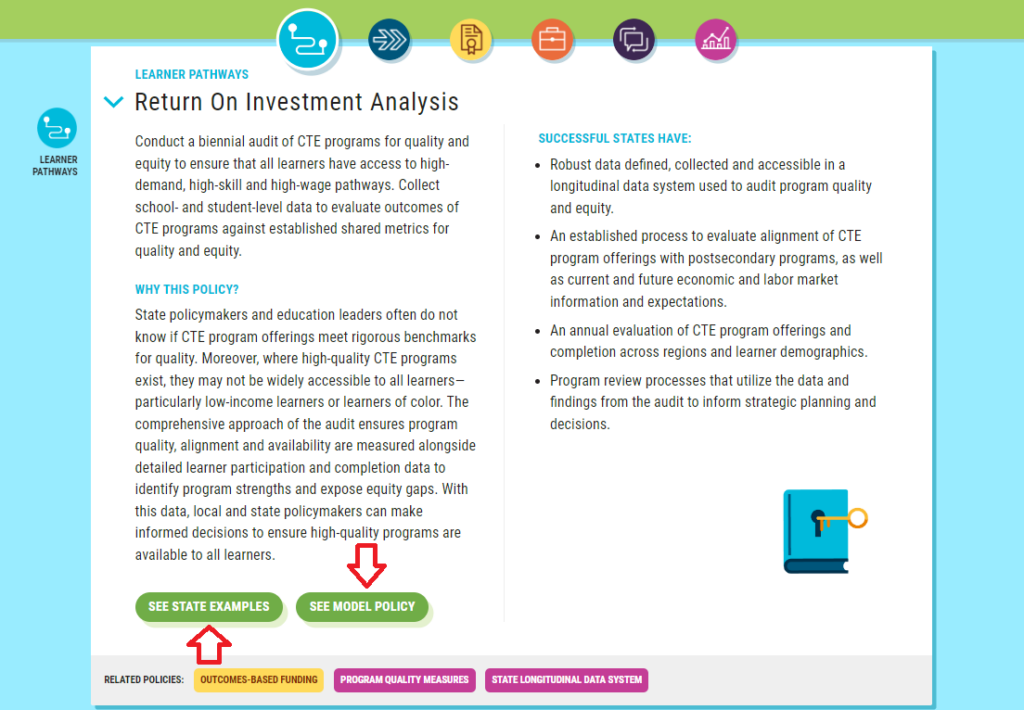
States increasingly want to know which programs are working well for students and employers—and which are not. To address this, two new model policies for a Return on Investment Analysis (ROI) have been added to the site. An ROI can help states answer three fundamental questions: 1) Are CTE programs aligned with what business and industry need; 2) What happens to learners who complete these programs; and 3) Who has access to which programs. This powerful data can be leveraged by policymakers to make improvements to benefit the economic security of the state and learners.
Pathways Matter state studies provide a snapshot of each state’s status vis-à-vis the 20 key policies in the Pathways Matter framework. To support states with continuous improvement, we also identify opportunities to strengthen each of their policies. Within each study, promising examples from other states are included to help policymakers consider relevant and potential ideas for change.
Each state study provides policymakers with an in-depth report that helps answer these strategic questions:
ExcelinEd’s policy team welcomes the opportunity to engage with states to support robust conversations across agencies to really dig and identify where and why the gaps are occurring—and then to develop a plan for prioritizing next steps.
