Christy Hovanetz, Ph.D., is a Senior Policy Fellow for ExcelinEd focusing on school accountability and math policies.


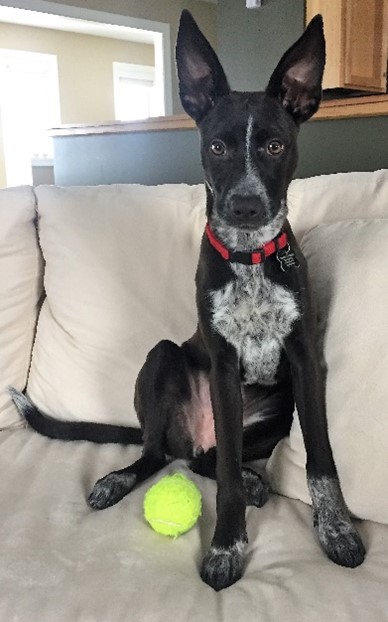
Five years ago today, a rescue puppy came to live with me. Her name is Summer. She has (mostly) grown into her unique ears, loves to play ball and has “number sense.” Yes, she knows math!
It’s a fact that most animals, including humans, are born with number sense. Evidence gathered from research with animals and studies of human infants suggests that basic numerical abilities are present at birth.
Number sense is a group of fundamental math abilities and skills that include concepts like “more or less” and “smaller or larger.” For humans, number sense skills are key to doing mathematics and many other tasks. In the animal world, number sense supports survival skills, such as an antelope deciding to run near one lion or the entire pride. It also helps with parenting skills, such as a hen checking she has all her chicks before sending out a search.
Researchers test number sense with dogs by setting up experiments with snacks. A pile of two snacks and a pile of five snacks are placed equally far from a dog. It’s probably not surprising (especially for dog owners) that when released, the dog usually chooses the pile with more snacks.
In another experiment, researchers arrange five snacks grouped closely together and another set of five snacks more spread out. The dogs usually choose the pile of snacks that is spread out, as it looks larger.
With people, some individuals have stronger number sense than others, but with practice it can developed and improved. As young children develop language skills, they also develop their number sense by learning the concepts of magnitude, ranking, comparison, measurement, rounding, percents and estimation. Number sense helps us apply math in the real world by making comparisons.
If someone claims not to be a “numbers person,” that’s, in a sense, nonsense…because we all have number sense! Implementing ExcelinEd’s math policy fundamental principles and the comprehensive K-8 math model policy makes sense, too, as they are based on the findings in the National Mathematics Advisory Panel Report.
Research suggests that dogs may know how to count and perform simple arithmetic. Researchers Rebecca E. West and Robert J. Young conducted several experiments with dogs and concluded “that the dogs were anticipating the outcome of the calculations they observed, thus suggesting that dogs may have a rudimentary ability to count.”
P.S. This is Summer, tennis ball-fetcher extraordinaire! She exhibits number sense and even knows the value of “one.” Whenever I say, “I will throw the ball one more time,” she retrieves the ball as usual…but doesn’t bring it back to me.