Amy Owen is the Senior Director, Digital and Teacher Policy at ExcelinEd.


The average price of an “affordable” home broadband internet package is about $93.
Whether that sounds like a bargain or too far beyond your budget depends in part on where you live.
According to recent research released by Pew Trust earlier this year, broadband affordability standards vary greatly based on region, state and county. This variation contributes to a significant digital divide, where families with access to broadband infrastructure are not actually able to afford it–even those solidly in the middle class.
Research shows that up to 30% of middle-class families may find so-called affordable prices to be out of reach. That puts everyone in the household, especially students, at a disadvantage.
The shift to online educational resources that accelerated during the pandemic has only continued as new educational technology and tools evolve. From online school portals that provide links to homework assignments, online quizzes and grades to research assignments that presume home internet access, students are increasingly expected to have home internet service to fully participate in their courses. New opportunities to take advanced or unique courses online also require reliable, fast connections. Yet the digital divide persists–and unequal affordability is a contributing factor.
When we talk about the “affordability” of home broadband services, we’re basing that measurement on the Federal Communications Commission’s definition: Broadband is affordable when it costs up to two percent of monthly household income.
The research from Pew Trust reinforces conventional wisdom that households at or below the federal poverty level struggle to afford home broadband.
But it’s not only low-income families who have to stretch their budgets to afford home broadband. The study raises similar concerns about disparities in broadband affordability for middle-class households.
Researchers defined a middle-class household as one that earns $40,000 to $150,000 annually, with the median affordable price at the FCC’s two-percent benchmark coming in at $93 per month.
Unfortunately, the income range used to define “middle class” is so broad that it masks differences in projected ability to pay for services between, for example, a household earning $40,000 annually (an estimated $67 per month) versus a household earning $150,000 annually (an estimated $250 per month).
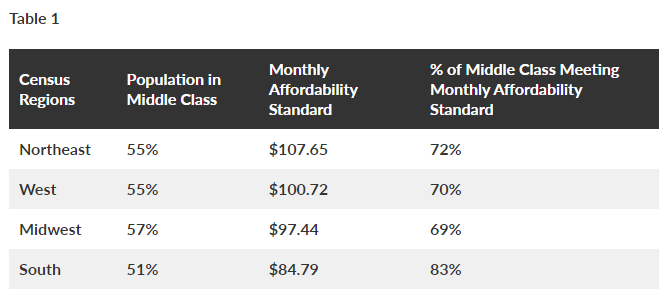
In reality, broadband subscription costs fall outside the affordability range for up to 30% of middle-class households. Table 1 from the Pew study indicates that only about 70% of middle-class families in the Northeast, West and Midwest could readily squeeze the affordable price into their budgets.
Policymaker Takeaway: Home broadband affordability is not solely an issue for low-income households. Broadband subsidies and other programs to improve affordability can benefit middle-income families as well.
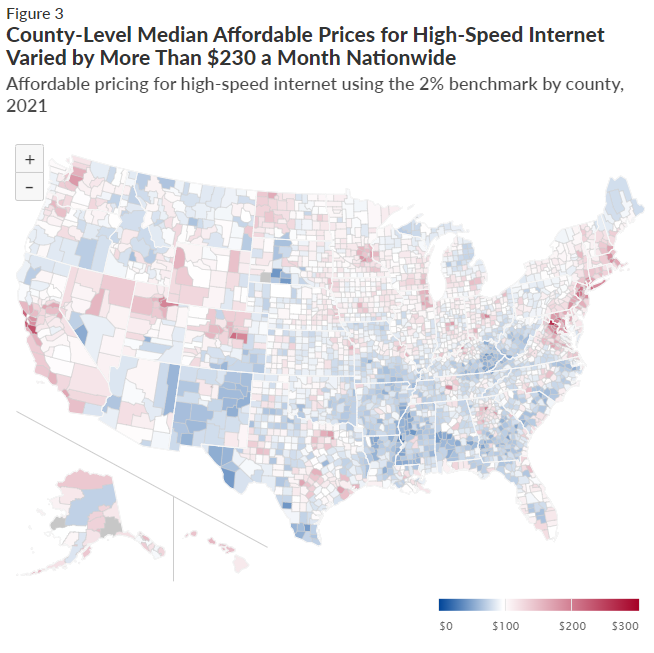
Using data at the state level, there are even more obvious differences in the ability to afford home broadband. Based on the FCC’s two-percent standard, the median affordable price in Rhode Island is $150 per month—but only $68 per month in Mississippi. The difference of $82 captures what would be deemed affordable for middle-class families in those two states.
When viewed nationwide, county-level trends show the starkest variation. The highest “affordable” broadband price at the two-percent benchmark was recorded at $261 per month in a Virginia county, while the lowest was recorded at $28 in a Mississippi county. These state- and county-level variations point to the need for policymakers to adopt customized solutions to expand broadband affordability for their constituents.

Policymaker Takeaway: Tailor broadband affordability solutions to the unique opportunities and challenges in your state. Use data to identify the communities with the greatest challenges to affording home broadband and double-down on efforts to help those communities get online.

To address the broadband affordability gap and increase access to services, Gov. John Bel Edwards (Louisiana) and Gov. Wes Moore (Maryland) have developed in-state partnerships that support Affordable Connectivity Program (ACP) adoption in their states’ unique contexts. These programs have key components such as raising public awareness, leveraging trusted community institutions like schools and libraries, and putting federal broadband expansion and equity funds to the best possible use.
Other states, such as Arizona and Utah, emphasize the role of “digital navigators” for assisting and supporting community members in getting online. In addition, ExcelinEd’s Closing the Digital Divide in Education Act model policy addresses the role that state education agencies and school districts can play in ensuring affordable broadband access for eligible students.
New research confirms that broadband affordability issues continue to hinder students from participating in online learning activities at home. With technology changing how students learn at school and at home, broadband access is a must-have resource at both locations.
Policymakers have an opportunity to address this challenge. They can review their state- and county-level data to identify areas where families are most likely to encounter affordability challenges. And they can implement practical, immediate solutions that improve students’ access to necessary educational technology by leveraging trusted community partners to raise awareness of and enrollment in broadband subsidy programs.
