Christy Hovanetz, Ph.D., is a Senior Policy Fellow for ExcelinEd focusing on school accountability and math policies.


Did you know February 5 is National Weatherperson’s Day? It’s a day to commemorate the 1744 birth of physician John Jeffries, one of America’s first weather observers. Jeffries made daily weather observations in Boston, starting in 1774. A decade later, in 1784, he collected weather data from a balloon aloft over London using a thermometer, barometer and hygrometer.
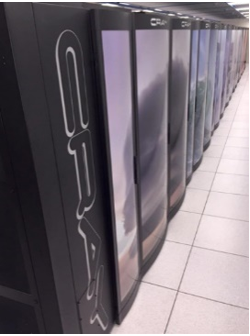
Today, scientists at the National Oceanic and Atmospheric Administration (NOAA) do similar tasks. They monitor the earth’s weather by collecting and organizing billions of data points from weather balloons, satellites, buoys, radars, water gauges, sensors on vessels and more. Information about temperature, air pressure, moisture, wind speed and water levels are used in a series of mathematical algorithms that run on supercomputers 24 hours a day, 7 days a week to predict weather more than two weeks into the future.
*Pictured: One of NOAA’s newest supercomputers crunches numbers 24/7 to assist with accurate weather predictions.
Weather-related calculations are extremely complex. Twin supercomputers in Virginia and Arizona each operate at a speed of 14.5 petaflops, processing 29 quadrillion calculations per second. NOAA’s research and development supercomputers in four states—West Virginia, Tennessee, Mississippi and Colorado—have a combined capacity of 20 petaflops. Together these supercomputers make NOAA’s computing system among the top 50 fastest in the world.
Have you ever heard of a petaflop? For context, a 1-petaflop computer system can perform one quadrillion floating-point operations per second! To match that, you’d have to perform one calculation every second for 31,688,765 years.
Numerical weather prediction, which uses math to model the future state of the earth’s atmosphere, was first used after World War II. But it took several decades, into the 1980s, when advancements in computing made possible the development of a global modeling system. Today, meteorologists are skilled in reviewing multiple models, each having different strengths and characteristics, to create forecasts with certainty. When model agreement is not possible, they can also show that uncertainty.
Some meteorologists are well known to the public for explaining weather forecasts on TV, although many work out of the public eye. As scientists and researchers, they use math, physics and computer science to study the layers of gases and moisture that comprise the Earth’s atmosphere to understand the weather, climate and the complex forces that shape and change the environment.
Over the past two centuries, we’ve come a long way from observing weather and collecting weather-related data to being able to accurately predict weather, almost to the minute. Unless you are a groundhog peaking your head aboveground in February to check for your shadow, predicting the weather is way more complicated—and requires lots of math!
Break out of a Groundhog Day’s endless time loop of declining math performance by implementing ideas in ExcelinEd’s comprehensive K-8 math policy fundamental principles and comprehensive K-8 math model policy. There’s not a shadow of doubt that these resources, based on findings from the National Mathematics Advisory Panel, can accurately forecast student success in math.
Punxsutawney Phil is a groundhog that lives in Pennsylvania. Tradition tells us that on February 2, if Phil sees his shadow and returns to his hole, he’s predicting six more weeks of winter weather. If Phil doesn’t see his shadow, he predicts an early spring. Last Friday, he predicted an early spring, but Phil would do better if he could learn some math—he’s right only about 40% of the time.
