Kymyona Burk, Ed.D., is a Senior Policy Fellow at ExcelinEd.


By Kymyona Burk, Ed.D.
Imagine a child standing before a locked door, the key just out of reach. This door leads to a world of knowledge, opportunity and self-discovery. Yet without the key of literacy, this child—and millions of others—will struggle to unlock that door to even get a glimpse of what lies within.
Alarmingly, recent data show that only one-third of fourth graders in the United States can read proficiently, highlighting critical and urgent challenges within our education system.
From nationwide research, we also know that:
Investing in effective, comprehensive early literacy policies offers the key to unlocking the potential of every child. Strong state-level policies will support educators, empower families and ensure all children are equipped in grades K-3 with the skills they need to become lifelong readers.
But what exactly does “comprehensive” look like? Join us for an informative session as we explore our newly updated national resource, Early Literacy Matters. This robust, interactive tool includes essential elements of our fundamental principles of early literacy policies and showcases states that are leading the way.
Our three-pronged approach to comprehensive early literacy policy includes educators, families and young readers.
To achieve that, our comprehensive policy breaks down into four key areas:
While strong policy is where change starts, policy implementation is the key to success and results.
Numerous tools provide basic information on which early literacy policies have been adopted. Early Literacy Matters 2.0 is the first tool of its kind to take such a deep dive into how state-level policy is being implemented.
Building on the original version, Early Literacy Matters 2.0 includes ExcelinEd’s 18 Early Literacy Fundamental Principles that cover early identification; family engagement; teacher training and support; intensive reading intervention; and retention as a last resort for students struggling to read on grade-level.
From that foundation of 18 principles, we conducted another 50-state scan, this time looking not just at what policies were “on the books,” but how states are implementing them on the ground. This updated tool also includes best practices from the states plus resources that states can borrow from each other.
Many states have adopted early literacy policies over the past decade, but not all have seen academic growth consistent with other states’ growth. Some have seen no growth at all. The goal of Early Literacy Matters 2.0 is to set forth a rubric along with ways states can strengthen policies and support state education agencies on closing the gaps between policy, implementation and successful student outcomes.
Early Literacy Matters 2.0 marries comprehensive early literacy policy with what states are doing to turn those policies into reality.

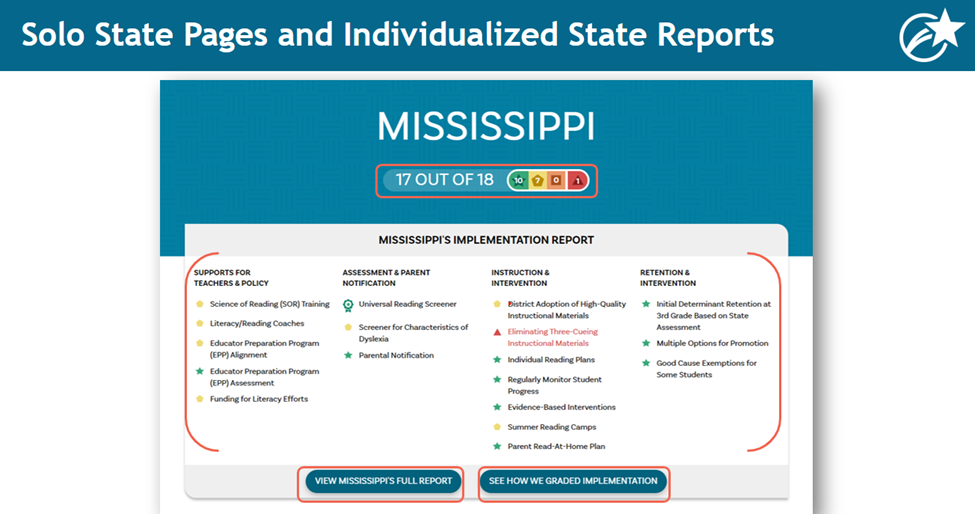
The new website includes a 50-state dashboard that shows which implementation level a state has achieved for each principle: Full Implementation, Partial Implementation, Future Implementation or Principle Not Adopted.

Dashboard users can filter the map by policy principle.

Users can get a look at the national landscape for a particular policy and drill down to the state level, where they can see how each state stacks up with all 18 principles.

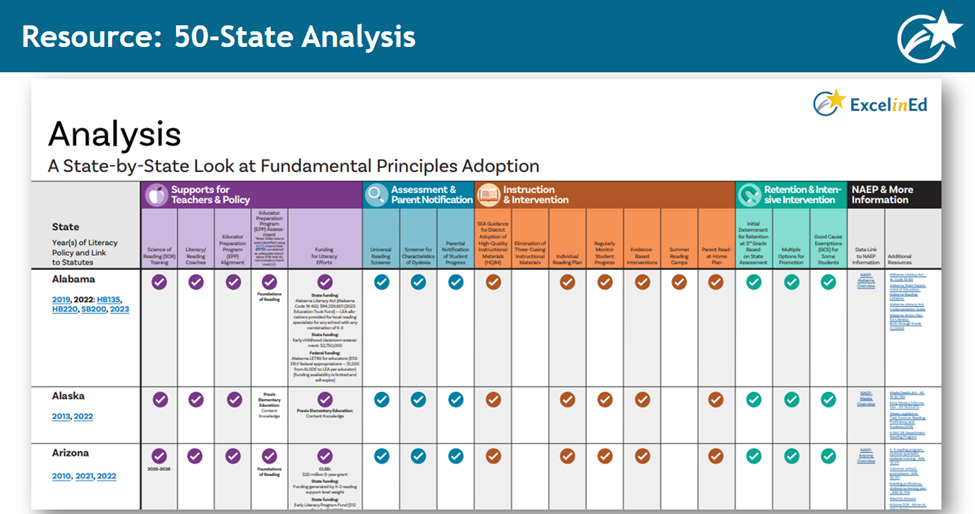
For those who want to see all 50 states in one PDF document, Early Literacy Matters features a downloadable 50-state scan that includes program details and code citations.
The new site is also mobile-responsive, allowing users to access the state-by-state breakdowns and policy principles on any device.
We hope you enjoy using the updated version of Early Literacy Matters. If you have questions or feedback about the resource, please contact one of our early literacy subject matter experts, listed at the bottom of this page.
