

Fifty years ago, Hungarian sculptor and architect Erno Rubik invented a three-dimensional geometric model with 27 colorful wooden blocks and rubber bands that allowed the blocks to move while retaining the cube shape. It took Rubik a month to solve his prototype cube, turning the cube’s six faces until each one was a single color.
In 1980, the Rubik’s Cube made its international debut and has since become a pop culture icon.
At the beginning, Professor Rubik was simply designing a tool for his architecture students to appreciate space, “with its incredibly rich possibilities, space alteration by architectural objects, objects’ transformation in space – sculpture and design – and movement in space and in time….”
But solving this puzzle to make all nine squares on each of the six sides the same color is also a mathematical matter. Rubik’s Cube has proven to be a useful tool for teaching algebraic group theory, specifically the two basic ideas of “commutators” and “conjugates” that facilitate solving the cube.
A commutator is a sequence of moves designed to isolate and swap or rotate specific pieces on the Rubik’s Cube while leaving the rest of the cube unchanged. Cube solutions are mainly based on commutators.
A conjugate involves using a move sequence to bring pieces into a position where a known algorithm can be applied effectively, and then returning the pieces to their original location.
In solutions guides, the Rubik’s Cube has its own standard notations—Up, Down, Right, Left, Face and Back (U, D, R, L, F, B)—that refer to the different layers of the cube. These notations are relative and determined based on the cube’s orientation. “Face” is always the layer that faces you when holding the cube. An apostrophe indicates the layer should rotate counterclockwise 90 degrees; otherwise moves are clockwise. Commutator and conjugate algorithms using these notations are directions used to solve the Cube.
There are over 43 quintillion—43,252,003,274,489,856,000—Cube combinations. For comparison, there are only 9.2 quintillion ways to fill out a March Madness bracket and only 7.5 quintillion grains of sand on all the Earth’s beaches and deserts.
Surprisingly, shortly after the toy’s debut in 1981, it was estimated that the fewest moves needed to solve Rubik’s Cube was 52.
Today, it is confirmed that the fewest moves needed is just 20! This was proven in 2010 when Google donated 36 CPU-years (central processing unit) of idle computer time to run a program that solved every one of the more than 43 quintillion starting positions of the Rubik’s Cube in fewer than 21 moves.
If, like me, you are not among that elite groups of cube solvers, the solution guide of algorithms on the toy’s website makes solving it possible. You do not need an intimate understanding of group theory to be successful, but understanding math vocabulary and concepts is definitely necessary. These concepts include face, surface, front, back, rotate, clockwise, edge, corner, ¼ (fractions!), turn and inverse. Happy puzzle-solving!
Looking to turn student math achievement trends upward? ExcelinEd takes the puzzle out of implementing a comprehensive K-8 math model policy based on fundamental principles from the National Mathematics Advisory Panel.
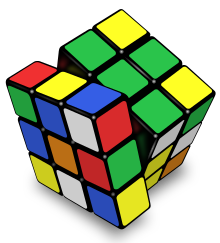
The Rubik’s Cube was inducted into the National Toy Hall of Fame in 2014. More than 500 million Rubik’s Cubes have been sold, and more than 50 books, hundreds of papers and countless websites have been dedicated to describing how to solve the puzzle of Rubik’s Cube.
If you are a great Cuber, consider joining a World Cube Association competition. Try your skill to join the ranking board. Perhaps you can knock off leader Max Park, who solved the cube in 3.13 seconds, or second-ranked Luke Garrett, who solved it in 3.44 seconds. It’s unlikely either of them will ever beat the bot designed by Mitsubishi Electric engineers that recently solved the puzzle in 0.305 seconds, so fast that the cube itself had trouble keeping up with the machine.
All of these times are amazingly faster than the month it took Rubik to solve his own prototype cube!
