

Last Updated: February 18, 2026
The rise of smartphones and social media has been linked to adverse outcomes for young people. Research, including findings from the American Academy of Pediatrics and insights from social psychologist Jonathan Haidt, associates excessive screen time with increased rates of anxiety, depression and sleep deprivation among children and teenagers. Young girls are particularly vulnerable to the harms of social media.
We also know educational outcomes are at risk, which is our focus as we work to transform K-12 education to ensure success for every child with student-centered, state-based policy solutions. How can we limit distractions in the classroom so students can learn and educators can do their jobs?
The most recent data from the International Organization for Economic Co-operation and Development (OECD) paints a clear picture of the correlation between screen time and academic performance.
The OECD data show the best way to eliminate distractions in the classroom is a full ban on cell phones on school premises. The data also suggest that the more leisure time students spent on devices and social media, especially during the school day, the lower their academic performance in math.

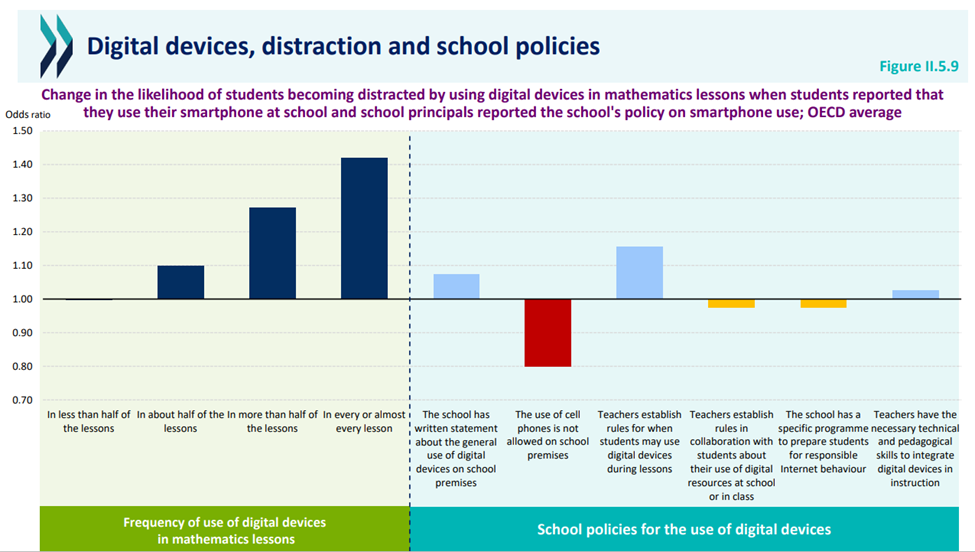
Causal research also supports this claim. The presence of cell phones in classrooms disrupts the learning process, as evidenced by declining test scores and increasing reports of classroom distractions, with low-income students often the most affected.
Teachers overwhelmingly express concerns about the negative impact of cell phones on student attention and students’ social-emotional development and mental health.
Several states have already taken legislative steps to mitigate these issues. As of late 2025, at least 35 states passed bills that restrict cell phone use in schools. A snapshot of major legislation in states is included at the end of this post.
The recommendations below outline strategies both state education agencies and policymakers can leverage to strengthen cell phone and social media guidelines in states, as well as examples of pioneers who have already done so.
States should implement a comprehensive ban on cell phone use during the school day. Exceptions can be made for educational purposes under teacher supervision or for emergencies.
While they do not have a full school day policy, Florida’s legislation is the first to prohibit cell phone use during instructional time and incorporating broader digital well-being measures. Additionally, Orange County Schools in Florida took it one step further by barring the use of cell phones for the entire school day. They saw increased student engagement.
As of 2025, New York passed a statewide “bell-to-bell” restriction on the use of cell phones in schools. Meanwhile, Wisconsin enacted a law requiring all public school districts to prohibit student cellphone use during instructional time, creating a standard that many districts had in place already to address concerns about learning disruptions.
Los Angeles Unified School District (LAUSD), the nation’s second largest school district, recently approved a measure that prohibits cell phones during the school day. New York City public schools have also implemented a cell phone ban.
States should provide model policies for districts to adopt regarding cell phone use in schools. For example, Ohio’s model policy prohibits student cell phone use at all times (with exceptions for students with health concerns or individualized education plans) and outlines disciplinary measures for violations.
States should provide funding for schools to acquire phone storage solutions such as lockers or pouches to secure devices during the school day. The use of Yondr pouches in Bethlehem Central School District led to a “completely transformational” shift in student outcomes, engagement and culture. A 2024 study also found that after implementing Yondr, student academic success rates increased by up to 6.27%, accompanied by a 44% decrease in average monthly behavioral referrals.
Finally, states should provide mental health funds to support school district efforts. In 2023, Pennsylvania provided $100 million in new funding to schools for student mental health care.
Parents play a pivotal role in helping to ensure that students limit their cell phone and social media access. States can provide resources to districts to share outlining common approaches and messaging to parents such as:
These laws, popularized by the “Let Grow” movement, support parents allowing their children opportunities to practice resilience without fear of criminal prosecution or social services investigations. These laws have passed with strong bipartisan support in Utah, Oklahoma, Texas, Colorado, Virginia, Illinois and Connecticut.
Digital literacy is crucial as it supports broader digital citizenship education, particularly in classroom settings where technologies like laptops are prevalent. This includes teaching students to responsibly engage with digital platforms, use technology for research and communication, critically evaluate news and information sources and understand the impact of social media on mental health and well-being.
New Jersey mandates K-12 information literacy instruction under the New Jersey Student Learning Standards, encompassing digital, visual, media, textual and technological literacy.
State policymakers play a crucial role in mitigating cell phone distractions in the classroom to foster a more conducive learning environment. By enacting legislation that sets clear guidelines on cell phone usage, supporting schools in implementing technology-free zones and promoting digital literacy programs, policymakers can significantly reduce the negative impact of mobile devices on students’ academic performance.
Through a combination of regulation, education and support, state policymakers can help create classrooms where teachers can teach and students can focus, engage and thrive without the constant interruption of cell phones.
Smartphones and emerging AI technology are presenting new challenges for student focus and learning in the classroom. At the 2025 ExcelinEd National Summit on Education, experts shared insights and strategies around the ubiquity of technology and the future of education.
As more states adopt policies to encourage distraction-free learning, renowned psychologist Angela Duckworth presents her latest research on what teachers are actually seeing in phone-free classrooms. Don’t miss this chance for a close-up look at what the data reveal about the policies’ impact. Duckworth’s evidence and insights will inspire every leader in education to put student achievement first—by creating classrooms where every child can be fully present, connect meaningfully with teachers and peers and engage deeply in the task of learning.
Artificial intelligence is rapidly transforming how we communicate, learn and work. How can we harness AI’s potential in education while building guardrails that foster authentic learning and ensure everyone’s safety? Join us for an eye-opening look at both the challenges and opportunities of AI, with a spotlight on how Utah’s State Board is tackling this fast-moving target, plus deep dives with two AI experts on the risks and guardrails needed to protect students.
Cell phone policies took school leaders, parents and state legislatures by storm over the past year. But do we know what actually happens when schools go phone-free? Explore findings from one of the first major studies on the topic and discover what the latest evidence reveals about classroom learning, student behavior, school culture and more.
The AI Legislation Tracker by Transparency Coalition is an interactive tool that provides real-time updates on state-level legislation related to artificial intelligence, including policies affecting education and classroom technology.
In 2025, the following states passed laws that regulate cell phone and personal device use in schools, aiming to reduce distractions and enhance student focus during the school day.
| State | Bill | Summary |
| Alabama | FOCUS Act | Prohibits students from using any wireless communication device in any public elementary or secondary school building or grounds thereof during the school day. |
| Florida | HB 1105 | Prohibits elementary and middle school students from using a wireless communications device during the school day. High school students may not use wireless devices during instructional time. |
| Indiana | SB 185 | Prohibits students from using a wireless communications device during instructional time. |
| Louisiana | SB 207 | Prohibits student use and possession of a wireless communications device throughout the instructional day. |
| New York | State Budget | Requires all public schools statewide to implement a bell-to-bell prohibition on student cellphone use during the entire school day. |
| State | Bill | Summary |
| Alaska | HB 57 | Requires districts to adopt policies that limit the use of cellphones during the school day. |
| Arizona | HB 2484 | Requires districts to adopt policies limiting cellphone use during the school day and communicate them annually to parents. |
| California | AB 3216 | Requires districts, charter schools and county offices to adopt policies limiting or prohibiting cellphone use by July 1, 2026 |
| Colorado | HB 25-1135 | Requires districts to adopt and implement a policy concerning student communication device possession and and use during the school day. |
| Iowa | HF 782 | Requires districts and charter schools to implement policies restricting student cellphone use during instructional time. |
| Minnesota | Statute 121A.73 | Requires districts and charter schools to adopt a policy on student cellphone use during the school day. |
| Nebraska | LB 140 | Requires districts to adopt policies limiting cellphone use in classrooms. |
| Nevada | SB 444 | Requires school boards to adopt policies limiting electronic device use during instructional time. |
| North Dakota | HB 1160 | Requires districts to implement policies requiring devices to be silenced or secured during the school day. |
| Oregon | EO 25-09 | Requires all K-12 schools to prohibit student use of personal electronic devices, with a requirement for districts to adopt policies and implement by January 1, 2026. |
| South Carolina | State Budget | Requires districts to adopt a policy that prohibits student access to personal electronic communication devices during the school day in order to receive state funds allocated for State Aid to Classrooms. |
| Texas | HB 1481 | Requires districts to adopt a policy that prohibits students’ use of personal communication devices during the school day. |
| Virginia | HB 1961 | Requires school boards to develop policies to restrict student use of cellphones from bell-to-bell during the school day. |
| Wisconsin | AB 42 | Requires districts to adopt a policy that prohibits students from using a wireless communication device during instructional time. |
| State | Bill | Summary |
| New Jersey | NJDOE Grant | Offers a minimum award of $500 per district, with additional funds dependent on student enrollment, to be sued for phone storage systems, etc. |
| New York | FY2026 Budget | Provides $13.5 million for implementation of policies, to include phone storage systems, administrative costs, etc. |
| State | Bill | Summary |
| Connecticut | Policy guidance | Emphasizes that schools should limit and thoughtfully manage student cell phone and personal technology use to reduce distractions, protect mental health, and create safe, engaging learning environments. |
| Maryland | State Board of Education Resolution | Encourages districts to adopt cellphone policies as soon as practicable. |
| North Carolina | Governor’s Advisory Council Report | Highlights early successes from districts implementing cellphone-free policies and recommends best practices. |
| Oregon | Policy guidance | Recommends districts update policies to limit or restrict personal device use during the school day. |
