

Many parents and caregivers can fondly remember their child snuggling next to them as they were lulled to sleep by a bedtime story.
For some, the soothing words and imagery of their favorite book provided the same comfort as a warm blanket. For others, the new stories became fodder for wonderful dreams and inspiration. This part of a daily bedtime routine is important not only for nurturing the bond between child and adult, but for helping to foster a child’s lifelong love of reading.
We know how important this connection can be, and that’s why we are launching a new library on our Early Literacy Matters website aimed at helping families find the resources they need to support their children reading at home, while reinforcing what they are learning at school.
To assist parents and caregivers in accessing high-quality resources that are aligned to the science of reading, ExcelinEd is excited to announce the launch of its curated resource library, Raising a Reader. The library organizes resources into four categories that address a wide range of topics:
You can access the tool by visiting our Early Literacy Matters website and clicking the “Parent Tools” option at the top of the page.
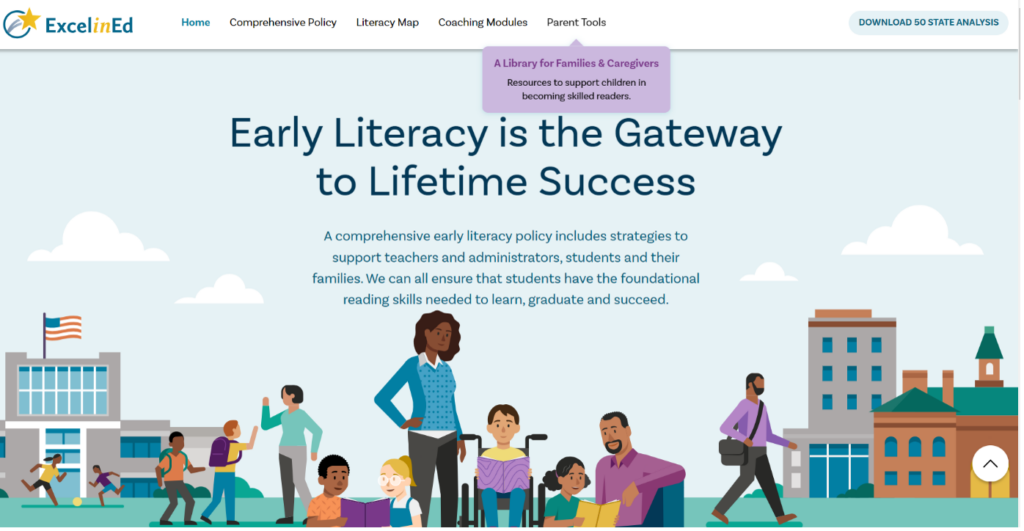

Within each category’s page, parents and caregivers can use the filter feature to view resources that address their topic or topics of interest. For example, under the “Building a Strong Foundation” category, you can filter for resources that address both “Exploring How a Child Learns to Read” and “Recognizing Learning Differences.”

Parents and teachers work as partners helping children become skilled readers. At ExcelinEd, we promote 18 principles of a comprehensive early literacy policy that support teachers, administrators, students and families with strategies to improve literacy outcomes.
Two of these components are parental notification and read-at-home plans. They are important for ensuring that families know if their child has been identified with a reading deficiency and are equipped with strategies that they can use at home to target their child’s needs. Currently, 39 states have parental notification systems in place, and 31 states have read-at-home plans in policy.
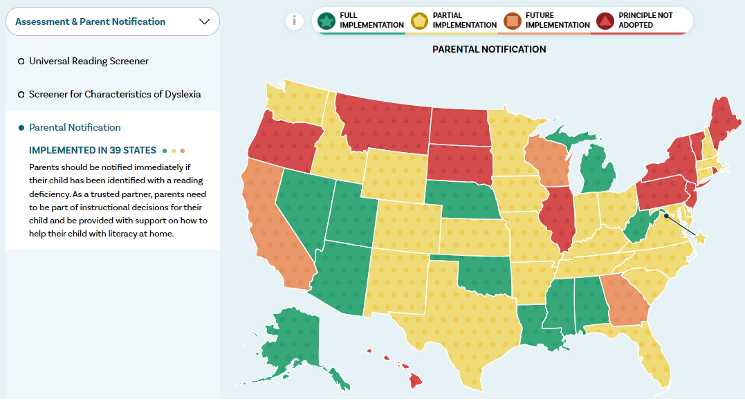
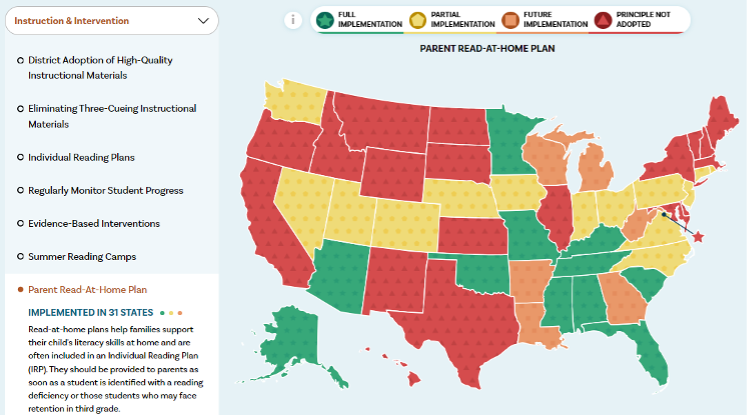
For families living in a state that doesn’t require parental notification or a parent read-at-home plan, making sure their child is getting the materials and attention they need to grow their ability to read can feel like a daunting task.
This especially rings true for districts that are not required to align their reading instruction or curriculum with the science of reading, which refers to the body of knowledge that is grounded in research and evidence-based practices and details how to best teach children to become proficient readers and writers.
More than five decades of research has proven that instruction based on the science of reading is more effective than three-cueing, which prompts developing readers to guess what an unfamiliar word may be instead of sounding out the word.
Learn more about the science of reading and the issues that three-cueing can cause through this panel discussion from ExcelinEd’s National Summit on Education:
As ExcelinEd works to close the gap between research and practice, we invite families to explore the Raising a Reader resource library to learn more about literacy development and ways to support their child’s reading at home.
