Matthew Joseph is a Senior Policy Advisor at ExcelinEd.

One of the biggest hurdles facing public charter schools across the country is securing affordable facilities. Traditional public schools raise thousands of dollars per student in local funding to pay for their facilities, but they rarely share these funds with charter schools. This means that charter schools often must pay for their facilities with their operating funds, which are intended to pay for instruction.
One way states are helping charter schools is reducing the cost of borrowing money to buy their own buildings. Idaho is leading the way providing massive benefit to charter schools at no cost to state taxpayers so they pay less to landlords and private investors and can invest significantly more in instruction.
This is a groundbreaking approach that other states should take note of. A new report from ExcelinEd and Bluum, Reducing Facilities Costs: A Case Study of Idaho’s Approach to Charter School Facilities Funding, highlights how Idaho has implemented policies that have bolstered charter school growth—all without costing taxpayers a dime.
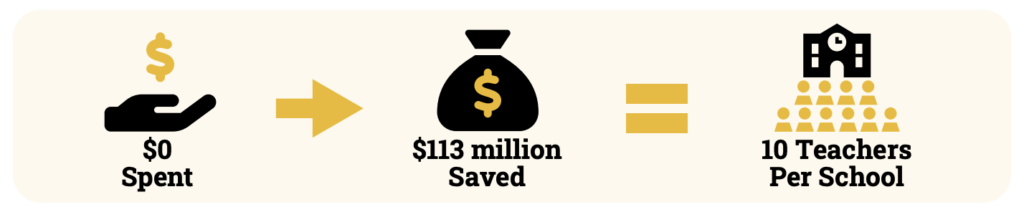
In the study, ExcelinEd examined the interest rates each charter school would have paid without the state’s support. The total savings are $113 million, which means that a charter school can hire 10 additional teachers.
This video explains how Idaho accomplished this feat and what charter schools have done with the savings.
Idaho is highlighting the huge benefit of well-designed facility financing policies that work together to leverage private investment and maximize savings so charter schools can invest more in instruction.
During their initial few years, charter schools in Idaho can get no-interest loans from the state’s revolving loan fund. Then the state helps charter schools get more affordable long-term private financing.
The cost to the state is $0. Schools are paying back their loans on time, and no school has defaulted. That’s because the state has established rigorous eligibility criteria to reduce risk to the lowest levels.
Further investigation found that the state is leveraging private support to multiply the savings. Schools participating in the revolving loan fund can get a low-interest match funded by a local foundation. With the loan and match secured, banks offered the remainder needed at even lower interest rates.
A nonprofit, Building Hope, makes sure that charter schools only have to pay off their existing loans when seeking long-term financing. A for-profit developer would require charter schools to pay for the updated value of the building, which is much higher.
Idaho’s approach is a compelling example for other states that want to expand public school options while being fiscally responsible. Charter schools need access to adequate facilities, and they shouldn’t have to choose between paying for buildings and investing in their students. By prioritizing low-risk high impact financing policies, Idaho ensures that charter schools can thrive without placing an additional burden on taxpayers.
Access to quality public education options is a priority in every state. For decades, public charter schools have played a vital role in delivering high-quality education, particularly in underserved communities.
Most state education funding systems do not fairly fund all students across public school options, particularly public charter schools. This funding gap stifles the growth of existing charter schools and limits the development of new quality public school options.
The ExcelinEd and Bluum study underscores several benefits of Idaho’s charter school facilities funding policies:
The success of Idaho’s model lies in its simplicity and fiscal prudence. Rather than directly funding facilities or deploying taxpayer dollars, Idaho leverages existing financial tools to create low-risk solutions that benefit both the state and its charter schools. By reducing financing costs, the state has opened the door for more charter schools to flourish, meeting the needs of students and families seeking alternatives to the traditional public school model.
Idaho’s success aligns closely with ExcelinEd’s Charter Facility Index, a framework for helping states assess and address the facilities needs of charter schools. The index outlines three key policy areas:
Idaho’s focus on financing demonstrates how a significant investment in one area can reduce the need for others. For example, by ensuring that charter schools can access affordable loans, the state reduces the need for direct funding or public facility access.
States looking for support to replicate Idaho’s success can turn to ExcelinEd for guidance. Our policy experts are ready to help craft solutions tailored to each state’s unique needs. By leveraging proven tools like the Charter School Facility Index, states can ensure that charter schools have the resources they need to grow, hire exceptional teachers and provide high-quality services for students.
Idaho has proven that with the right policies, it is possible to expand access to quality public education options in a way that benefits students, families, and taxpayers. Now is the time for other states to follow suit and embrace innovative solutions that empower public charter schools to succeed.
