Ben DeGrow is a Senior Policy Director of Education Choice for ExcelinEd.


States adopting universal private school choice programs face a supply problem: overly rigid accreditation rules can keep otherwise effective schools out of reach for families.
Private school choice is expanding rapidly across the country. More than a dozen states now have programs where nearly every student is eligible for a scholarship, voucher or Education Scholarship Account (ESA). Yet in many states, families are discovering a frustrating reality: demand is high, but supply can be limited.
Restrictive accreditation policies are one of the reasons why. Instead of broadening the marketplace of schools, these policies narrow it, excluding schools that could otherwise serve students well.
Accreditation is a process where an outside entity evaluates a school to determine if it meets a prescribed standard of quality. It’s designed to weed out the worst actors, creating a floor of quality, and it usually includes oversight of academic and financial practices.
In this post, you will learn:
This process, while well intentioned, presents three practical challenges:
Watch our short video to learn more:
As voucher and ESA programs scale to universal eligibility, more students should be able to access private schools. But in many states, there are not enough private school seats to meet demand. In some cases, private school supply is limited. In others, private schools may not meet requirements in the form of additional state regulations, such as accreditation.
For this analysis, ExcelinEd looked at eight states with large private school choice programs. In three of the eight states examined—Arkansas, Indiana and Iowa—programs require participating private schools to be accredited by the state or by another state-recognized accreditor. A fourth state, Ohio, enforces a set of operating standards that act similarly to accreditation.
States adopt accreditation requirements because they assume accreditation sets a minimum bar for quality and even deters bad actors, but there is little evidence this is the case. Instead, accreditation may instead be a burdensome hurdle—one that some schools don’t believe is worth the investment of time and money. State accreditation requirements could limit the number of options available to students in private school choice programs.
We acknowledge other factors, such as local zoning laws and startup costs, may prevent new private schools from being established in time to keep up with demand. We focused our research on accreditation because it can be measured program by program.
Examining private school choice programs with the largest numbers of students enrolled, we found evidence of a relationship between stricter accreditation requirements and lower program participation by private schools. Accreditation requirements may deter established schools from participating in school choice programs or delay the process of adding available seats through the creation of new schools.
ExcelinEd analyzed eight states with active, universal private school choice programs. Half required accreditation (or a very similar standard) for participating schools; half did not. The results were striking:
With a couple exceptions, we found a clear difference in private school participation between state programs that require accreditation and those that do not. Arizona, Florida, North Carolina and West Virginia all have participation rates ranging from 84% to 100%, while Arkansas, Indiana and Iowa’s rates range from 44% to 63%. These numbers do not prove direct causation, but they do point to a strong relationship between program accreditation requirements and limited options for participating students.
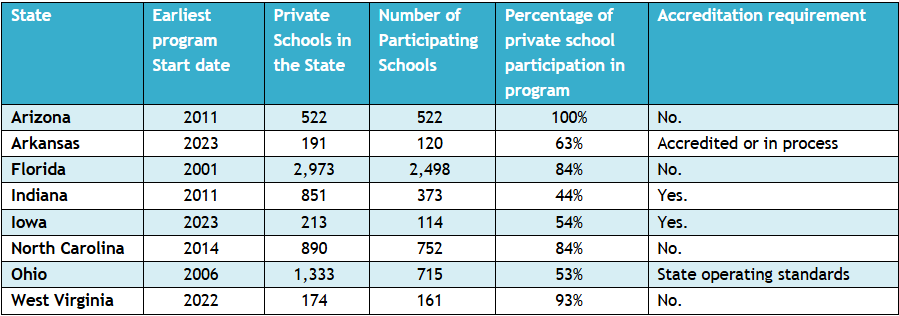
Other provider eligibility requirements also appear to limit private school participation. While Ohio does not require accreditation, per se, imposing similar standards may have a dampening effect.
Voucher-accepting schools in Ohio, which are known as “chartered nonpublic schools,” either must meet Ohio Operating Standards for Schools or be accredited by an association approved by the state board of education.
Ohio Operating Standards require a site visit, leadership training and compliance, minimum size requirements and other staffing requirements. Further, to be eligible for the two state programs that serve students with disabilities, schools must have specific medical professionals on staff to be eligible for participation. Ohio also requires schools not to increase tuition for students from households under 200% of the federal poverty level.
Half of Ohio’s private schools have declined to participate in the program, perhaps because they don’t want to meet those requirements.
Some states are embracing alternatives to accreditation that can expand the supply of quality options while deterring bad actors.
Removing an accreditation requirement does not mean abandoning all standards to approve private schools for scholarship program participation. As an alternative, for example, Florida calls for schools to pass a series of health and safety measures. This approach effectively preserves a floor of quality without imposing a mandate that could ultimately close many doors to students and families in need of education options.
Meanwhile, at least two different accrediting organizations are working to develop more streamlined processes to meet state accreditation requirements. First, Christian Schools International (CSI), recognized in multiple states, offers a module-based provisional accreditation process that can qualify both existing and startup schools to receive scholarship funding in less than six months. The model has been tested in Iowa and has been made available to prospective schools in several other states, as well.
Second, the Middle States Association is launching the Next Generation Accreditation project, which outlines an accreditation protocol for innovative school models like microschools and hybrid options. The project aims to expedite the timeline for accreditation, with the first cohort qualified to accept ESA funding in the 2026-27 school year. It remains to be seen how these initiatives can increase access to private schooling while addressing perceptions related to quality.
While these initiatives can restore some needed flexibility, they should be seen as ways to mitigate, rather than eliminate, the restrictive effects of accreditation requirements.
Most state policymakers aren’t trying to block families from choice. They support accreditation because they want to protect quality. But these rules often backfire, producing fewer options rather than increased opportunity.
What begins as a safeguard too often turns into a barrier, particularly for smaller or newer schools that can’t afford an expensive, lengthy process before opening their doors to families utilizing private school choice programs.
Accreditation is not inherently bad. But when applied as a blunt, mandatory policy, it reduces families’ options and undermines the promise of universal choice.
The evidence points us toward solutions: States with more flexible approaches see more schools open to families, giving students more places to thrive. If the goal of choice is truly to expand access, policymakers must ensure accreditation is not a roadblock standing in the way.
