Patricia Levesque is the Chief Executive Officer for ExcelinEd.


Last month, ExcelinEd hosted our annual National Summit on Education in New Orleans. The two-day conference featured a broad array of sessions and keynotes on topics from adolescent literacy and math to distraction-free learning and school choice.
But how do Americans feel about these policies—especially newer ideas related to math education and college and career pathways?
As state leaders work to improve academic outcomes and expand opportunities, new public opinion research reveals how Americans feel about different education policies being considered and implemented at the state level.
ExcelinEd partnered with UpOne Insights and Impact Research to better understand how Americans view today’s most important education issues. The national survey of 1,000 registered voters, conducted online from Sept. 22 to Oct. 1, 2025 (±3.53%), offers insights for policymakers navigating evolving challenges in education.
The results make one thing clear: Americans overwhelmingly support strong, proven education policies that put students first.
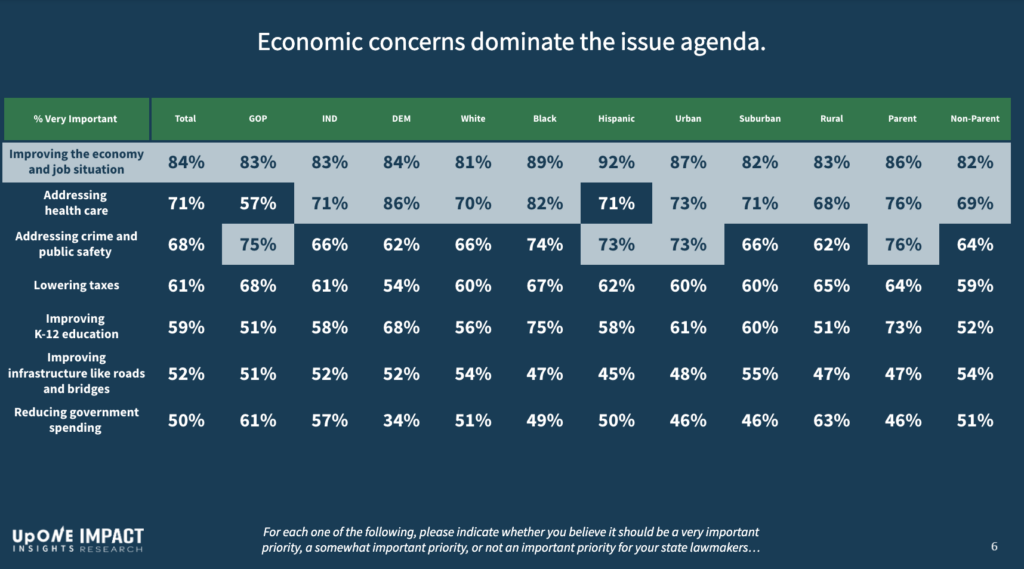
At ExcelinEd, we know strong education policy changes lives, and we work at the state level to spread those ideas. As we move through the survey in this post, it’s important to note that economic issues outweigh all other issues on Americans’ minds right now.
Education is still at the forefront, but we have to be mindful as we move forward that policymakers in the states are contending with many other challenges.
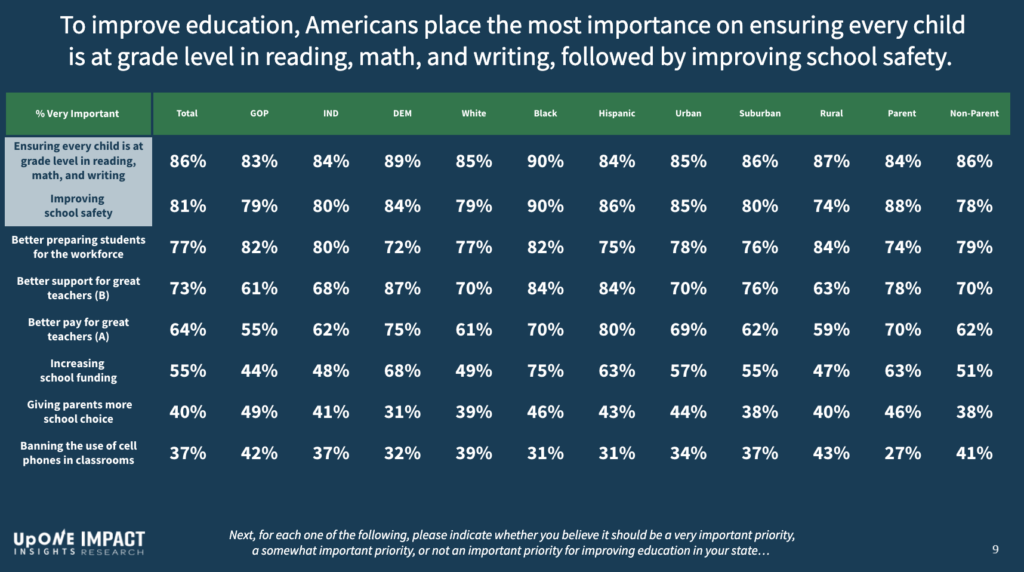
Once we consider education issues alone, a few key issues rise to the top: ensuring kids are at grade level in reading, math and writing; improving school safety; and better preparing students for the workforce.
Far and away, across every demographic area and including both parents and non-parents, Americans want to make sure kids have a strong academic foundation. That sets the stage for our work in fundamentals such as K-12 literacy—both early childhood and adolescent—and math. We’ll dive more into the latter policy area next.
Americans are right to be focused on the basics. After all, the 2024 National Assessment of Educational Progress (NAEP) scores released earlier this year showed continued setbacks in reading achievement for both fourth and eighth graders—both compared to 2019 levels and the last assessment in 2022.
In math, scores remained stagnant for eighth graders and saw a modest uptick for fourth graders, though those gains were largely concentrated among higher-performing students.
There’s still a lot of policy work that needs to be done to ensure students can catch up to pre-pandemic levels and move forward with greater proficiency in these foundational areas.
Math is a gateway to future success; we know early math skills and strong middle-school pathways propel students toward high-wage careers and lifelong economic mobility.
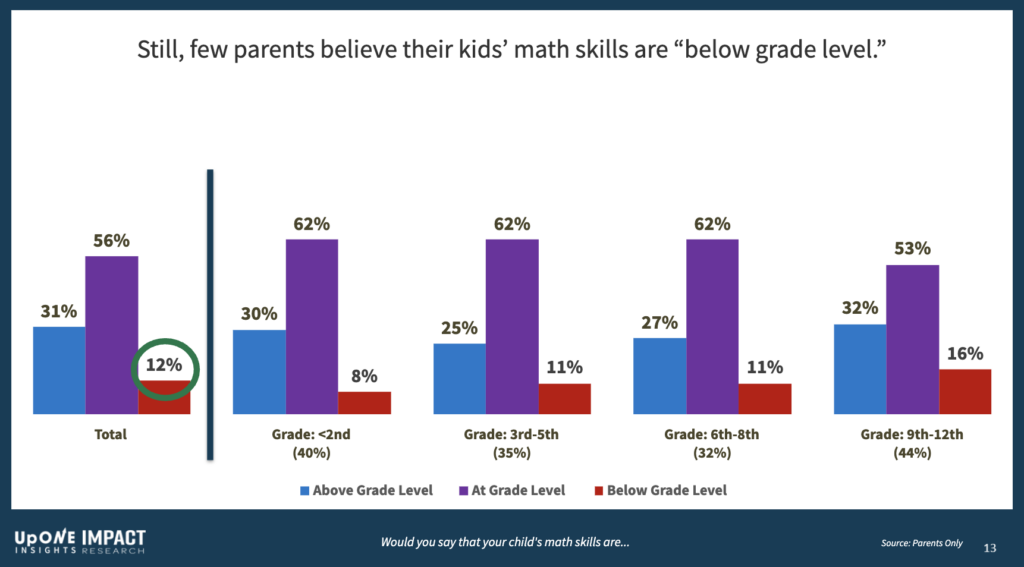
The aforementioned national declines in performance underscore the need for urgent action on math policy. Yet there’s a clear disconnect between how parents think their kids are doing and the reality reflected in NAEP scores.
One way to improve math scores is to ensure students receive at least 60 minutes of math instruction each school day. Consistent math instruction is vital for providing all students with a strong foundation. High-performing countries require 60 minutes of math per day. And Alabama, the only state whose fourth graders have returned to pre-pandemic levels of performance, is the only state that has implemented a 60-minutes-per-day math requirement in elementary grades.
When asked how they feel about a proposal that would connect students with an hour of math each day, respondents registered strong support:

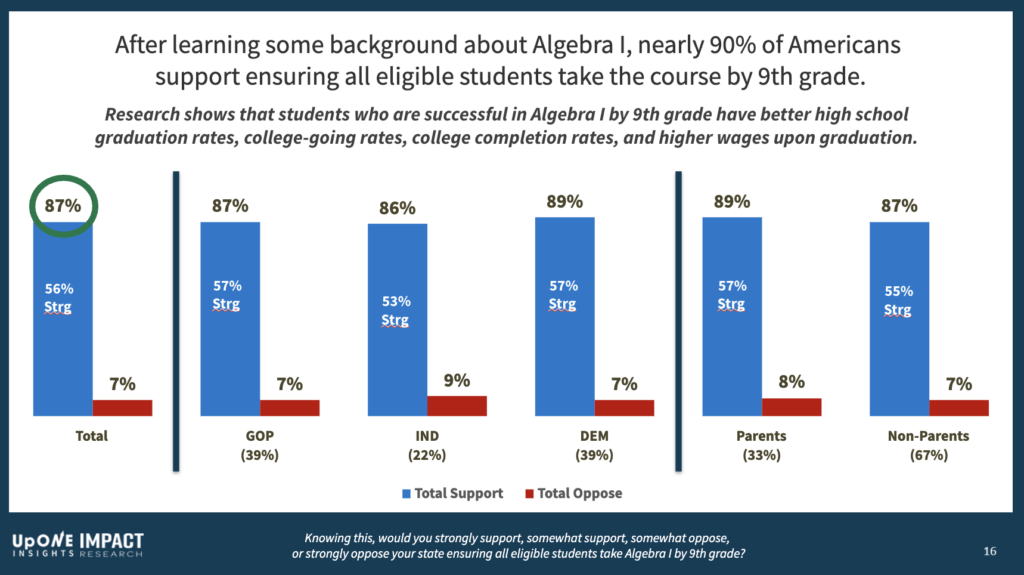
Research also bears out that success in Algebra I correlates with success later in life. ExcelinEd supports requiring students to take and pass Algebra I/Integrated Math I (IM I) no later than ninth grade to ensure students are mathematically prepared for high school and postsecondary opportunities. This policy also registered strong support:
Another proven math policy that’s been adopted in a handful of states is called guaranteed access. It ensures that students who are mathematically ready are identified and enrolled in advanced math that leads to Algebra I in middle school, ensuring high performers are able to reach higher level math courses once they are in high school. Support also is high for guaranteed access:
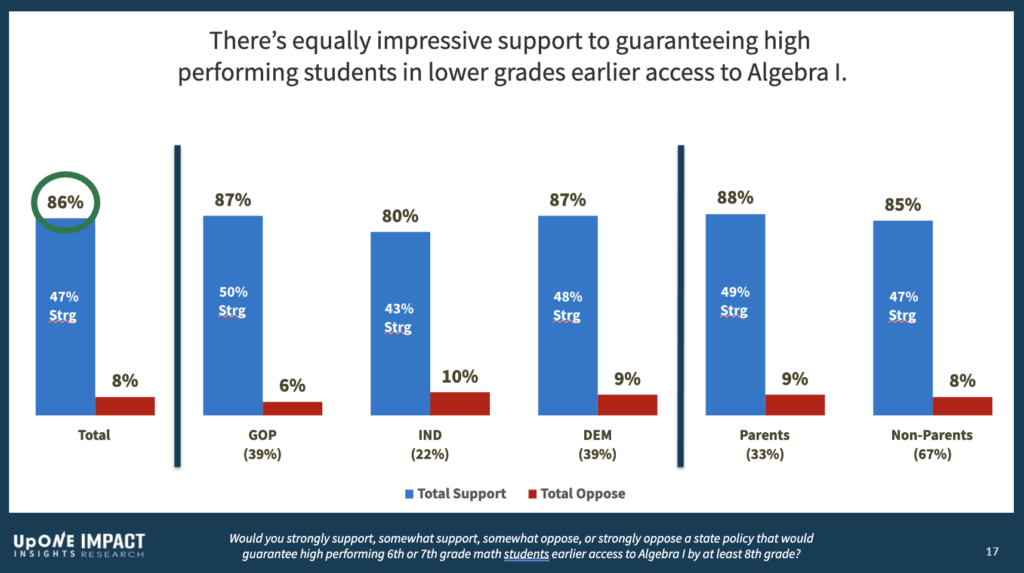
As states explore ways they can improve math policy, ExcelinEd’s new Math Matters digital tool gives policymakers the ability to see how they’re doing in 11 key policy areas that we know will lead to better outcomes.
The word “accountability” sometimes conjures negative reactions about the emotional toll of testing or how much time is spent ensuring students know the material for a test.
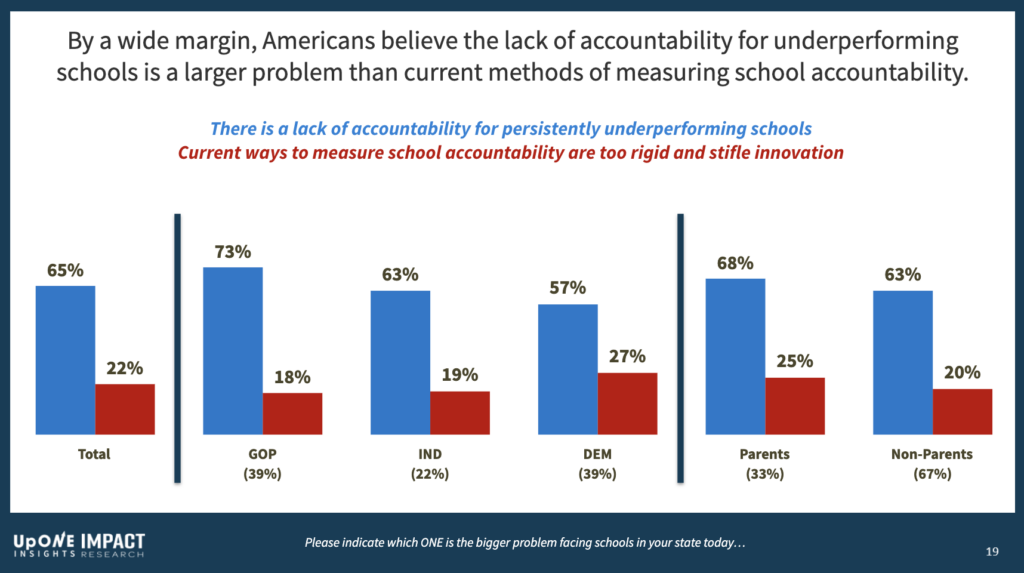
Those headlines do not reflect reality. Americans want clear information about school performance. In fact, according to our survey, by a margin of two-to-one, they believe a lack of accountability for underperforming schools is a far greater challenge than the ways in which students and schools are measured.
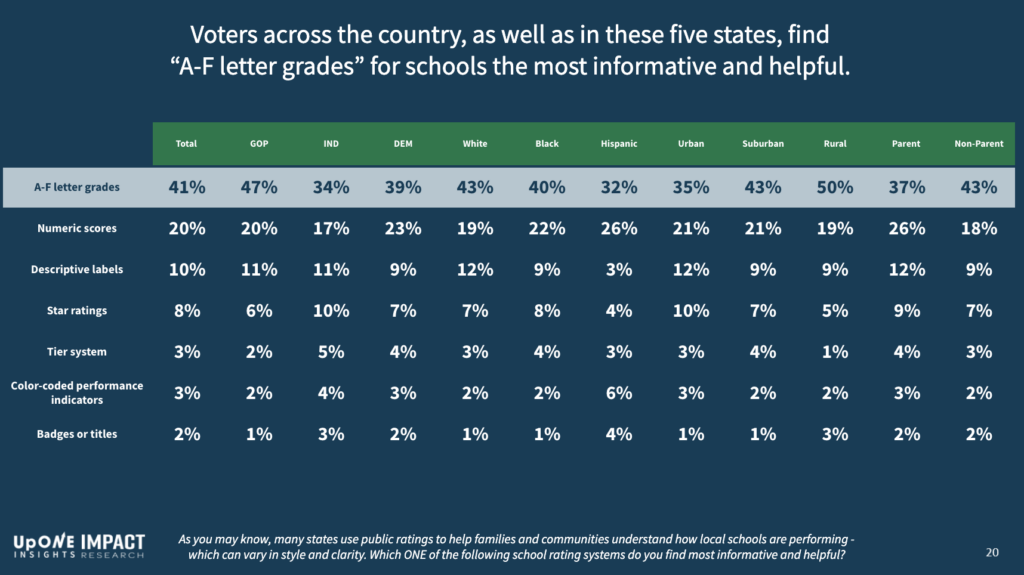
When asked how they want information about schools to be presented publicly, respondents had a clear favorite: A-F letter grades.
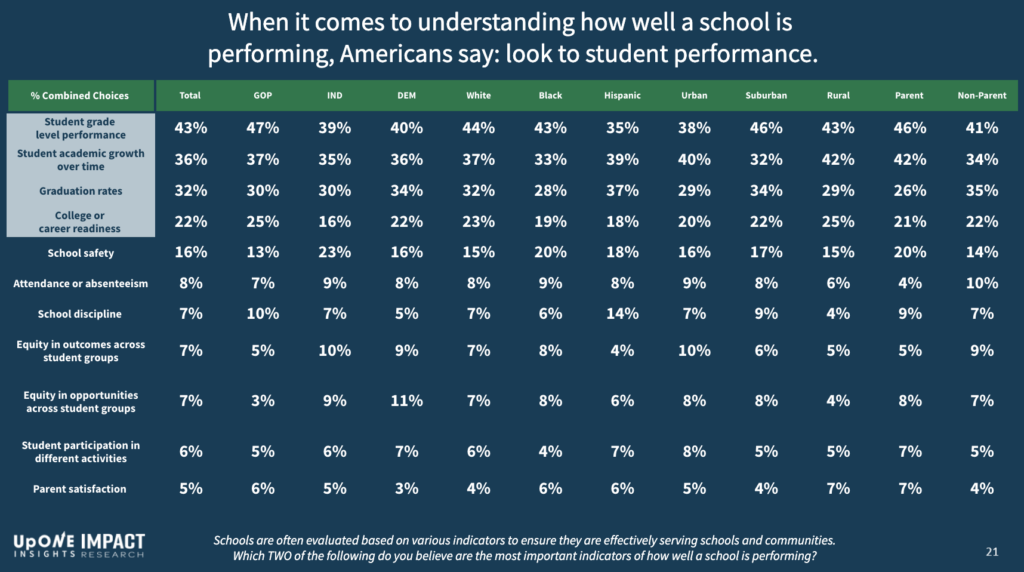
And when it comes to understanding how well a school is doing, respondents clearly chose student grade-level performance, student academic growth over time and graduation rates above all other options.
Contrary to the criticisms often lobbed at school accountability, support for these systems is strong. Americans want to know how students are doing. They want that information provided in A-F ratings. And they believe it should be measured against a grade level standard that students are expected to master.
State policymakers should lean into strong accountability and meaningful assessments to make certain students are learning and schools are improving and to empower parents with the knowledge to advocate for their children.
ExcelinEd continues to champion transparent school report cards, strong proficiency standards and data-driven decisions that ensure students don’t get lost in the system. The polling shows Americans agree: accountability matters.
Teachers are at the heart of student success. With growing workforce challenges in certain areas such as math and special education, Americans understand the need for solutions that elevate teaching, from improved preparation and certification pathways to competitive compensation and access to high-quality instructional materials.
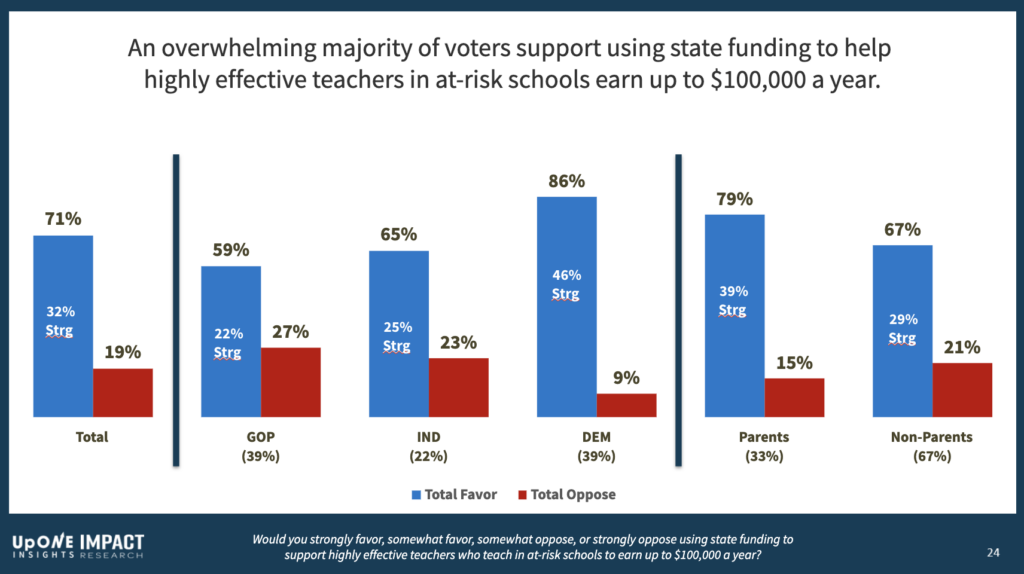
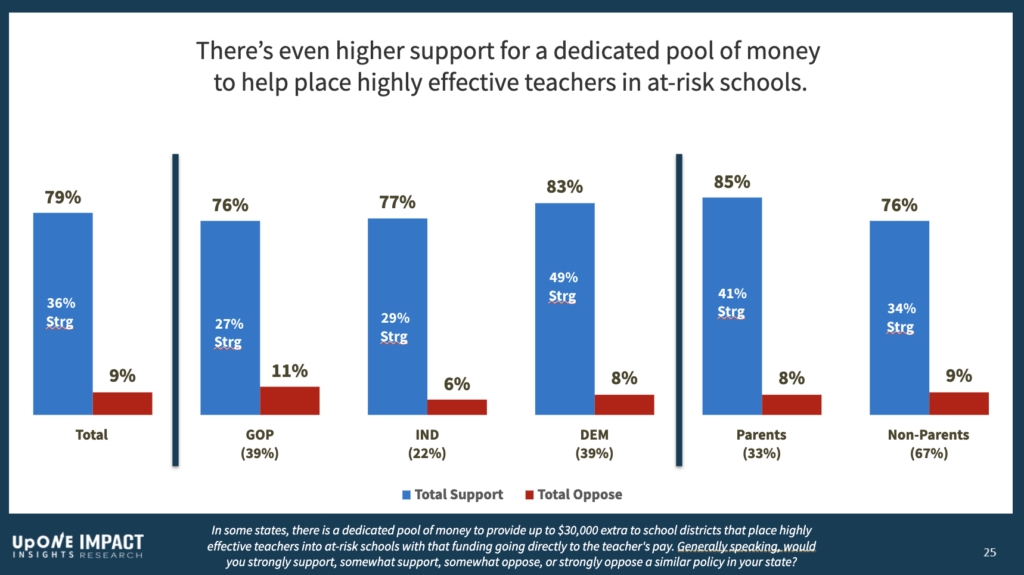
Our survey revealed support for states to increase pay for highly effective teachers in at-risk schools and even higher support for states to have a funding pool specifically dedicated to that goal.
Texas is leading the way in this policy with the state’s Teacher Incentive Allotment, a program that identifies highly effective teachers based on classroom performance and student outcomes, rewards those teachers with higher pay and provides extra incentive pay if they choose to take their skills to high need schools. TIA has successfully reduced teacher turnover, with the largest turnover reductions by high-performing teachers and teachers in rural districts.
ExcelinEd will continue to partner with states to strengthen and modernize the teaching profession so that every student in every school has access to a quality education.
Dozens of states have adopted different approaches to school choice over the past decade, from Education Scholarship Accounts (ESAs) to voucher programs to public charter schools.
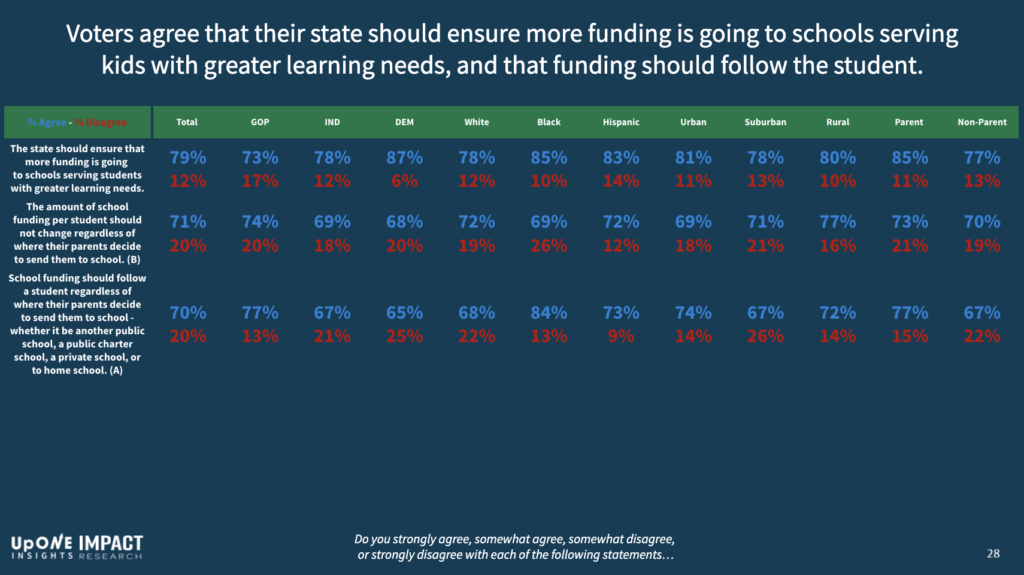
Funding for these programs varies from state to state, which raises questions of fairness as students increasingly move from one schooling type to another. Should funding follow the student no matter what school they choose? How should the funding formula account for students with different learning needs?
In our survey, 79% of respondents said the state should ensure more funding is going to schools that serve students with greater learning needs, and 71% said student funding should not change regardless of where parents decide to send their kids.
ExcelinEd recently released a funding parity model that is truly student-centered, following students to the educational environment that fits their needs
The formula would set a base amount that fairly reflects the funding traditional public schools receive and then build on that base amount with funding for students with specific learning disabilities, English language learners and low-income students.
The approach yields a simplified, universal weighted student funding formula that would provide true funding parity, ensuring that all students—regardless of the school or schooling type they attend—receive adequate resources tailored to their educational needs.
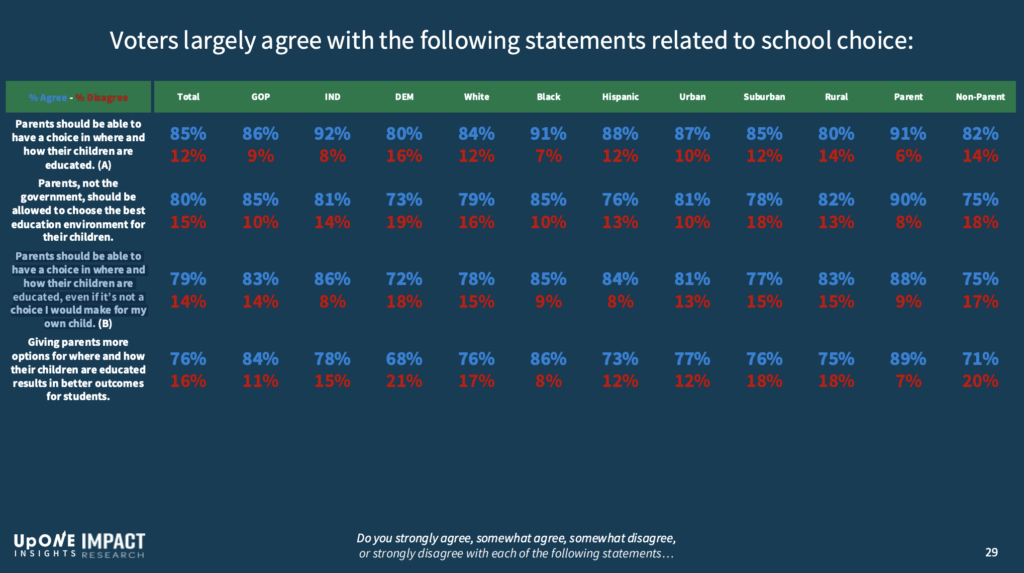
Beyond funding, the survey also found strong support for school choice generally—including support for the idea that parents should be able to have a choice in where and how their children are educated even if it’s not a choice the respondent would make for their own child.
Education should lead to opportunity, whether that means enrollment in college, enlistment in the military or employment in a high-quality job right out of high school.
Using our newly relaunched Pathways Matter digital tool and a suite of policy recommendations, ExcelinEd works with states to align K-12 and postsecondary with creating high quality opportunities for learners through alignment with workforce demand, expanded credential opportunities and ensure seamless transitions after graduation.
The poll shows Americans aren’t sure high school students are prepared for life after high school.
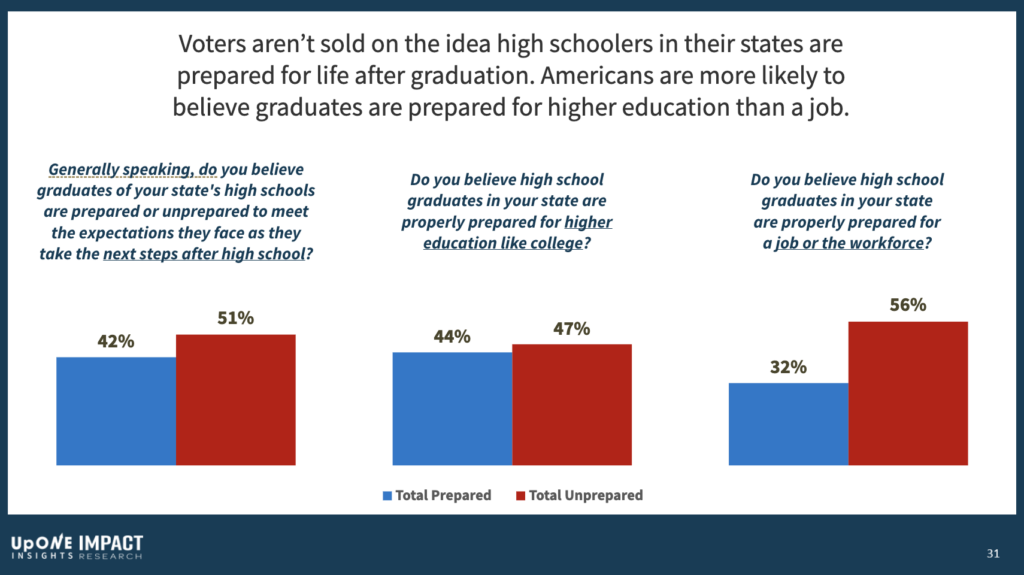
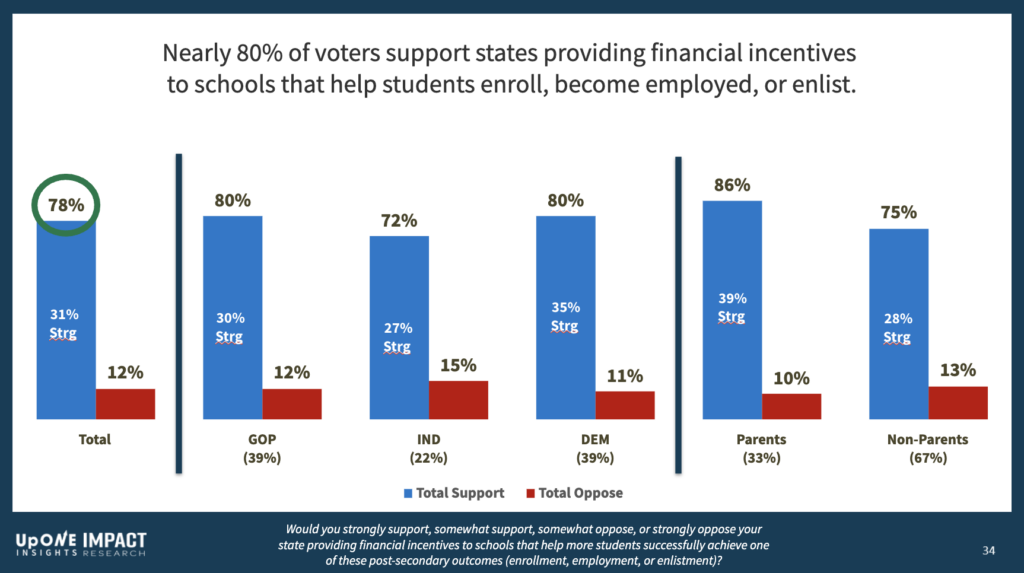
Nearly 80% of respondents support state incentives for schools that help students enroll, enlist or find employment after graduation, indicating an opportunity for policymakers to better align the high school experience with real-life outcomes.
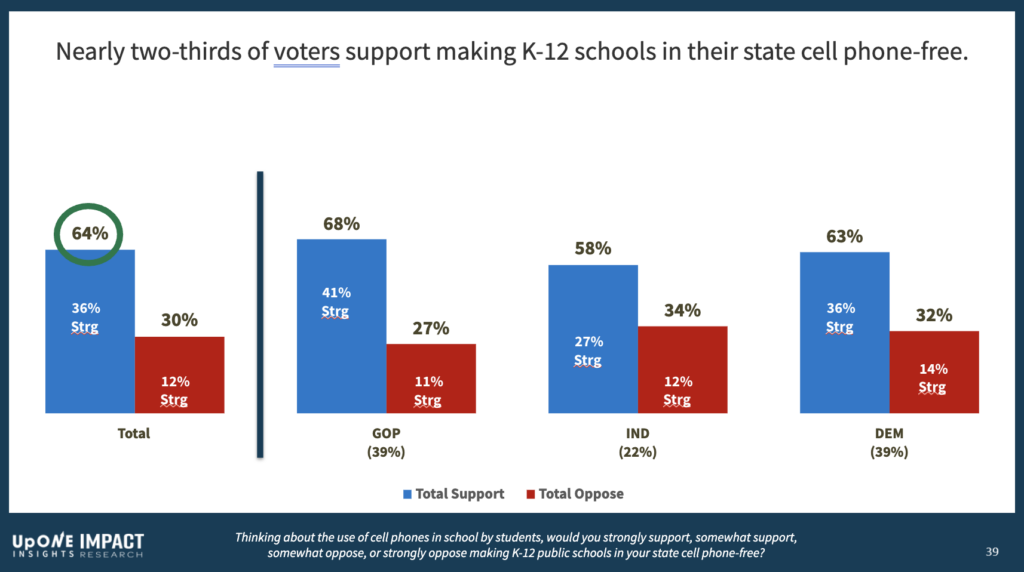
As schools confront rising concerns around distraction, student safety and mental health, a growing number of states are adopting policies limiting personal cell phone use during the school day. This is a national conversation with bipartisan support, and Americans are overwhelmingly supportive.
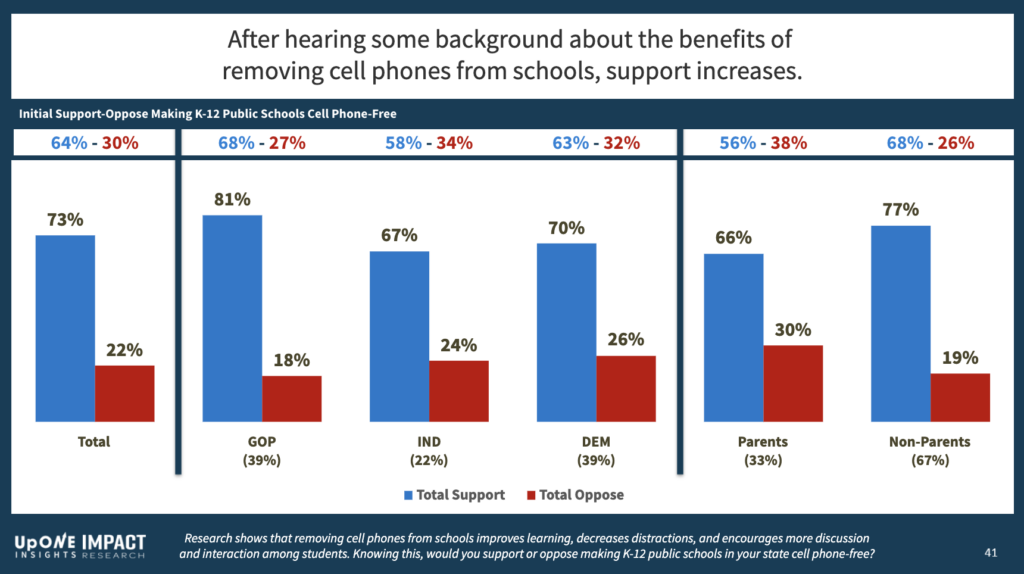
Support grows even stronger once respondents learn about the positive benefits around distraction-free learning, including improving learning, decreasing distractions, and encouraging more discussion and interaction among students—a nine-point increase from already strong support.
ExcelinEd will continue to support state leaders as they navigate responsible, student-focused strategies that prioritize engagement and learning in the classroom.
This national polling provides a clear blueprint: Americans want strong state education policies that boost achievement, support teachers, provide transparency, equitably fund students and prepare them for tomorrow’s economy.
There is broad alignment—across communities and political lines—around the kinds of reforms that work.
ExcelinEd is ready to help.
Interested in bringing these policies to your state? Connect with ExcelinEd’s policy team to learn more about the poll results and explore solutions tailored to your state’s needs. Together, we can ensure student-centered policies continue to change lives.
Read the full slide deck covered in this post:
