Adriana Harrington is the Managing Director of Policy for ExcelinEd.


For decades, the Pell Grant has been the backbone of college affordability in America, federal, need-based aid that helps low- and moderate-income students pay for postsecondary education. Unlike a loan, it never has to be paid back. It has also included a quiet assumption that the path worth subsidizing is a longer-term, more traditional degree program.
Workforce Pell changes that assumption by extending Pell eligibility to high-quality, short-term workforce training, programs that can be as short as roughly eight weeks that prepare students for high-skill, high-wage, in-demand jobs.
Imagine a 12-week welding certificate instead of a four-year degree.
This is a big deal because it opens federal aid to learners who have historically been least able to take eight weeks off work without financial support, and it does so at a moment when employers are hungry for skilled workers.
But expanding Pell into the short-term credential market also means expanding it into one of the least regulated, least transparent corners of American education. It’s an opportunity for states to make sure this new opportunity for students actually winds up connecting students to meaningful opportunities.
The scale of the credential landscape is staggering. There are roughly 1.8 million distinct credentials in the United States—including degrees, certificates, certifications, micro-credentials, badges and licenses—offered by more than 134,000 providers. Spending on credentials reaches into the billions.
Volume isn’t the same thing as value. Most credentials don’t deliver meaningful economic returns; a comparatively small share of high-value credentials does all the heavy lifting. Some sectors—health care, IT, advanced manufacturing—are dense with credentials of value. Others, like general business and retail, largely are not.
Workforce-based research sharpens the point. An analysis from AEI and the Burning Glass Institute found that only about 12% of credentials produce significant wage gains, with the top decile yielding annual wage increases of nearly $5,000. Bottom-tier credentials deliver few or no benefits at all.
Brookings research adds an important nuance: job-relevant credentials boost wages roughly twice as much for workers without a college degree as for college graduates, and relevant credentials carry a wage premium twice the size of irrelevant ones. Accumulating irrelevant credentials can actually reduce wages.
Read that last sentence again. The downside for a badly designed credential system isn’t neutral. It’s negative. And the people most exposed to that downside are precisely the learners Workforce Pell is designed to serve.
Tennessee offers a concrete illustration. A 2024 ExcelinEd study of the state’s K–12 and postsecondary credential alignment found that just 10% of credentials promoted by Tennessee Colleges of Applied Technology and 18% of those promoted by community colleges were actually in demand with Tennessee employers. Only half of all credentials students earned were demanded by employers in the state.
There are federal rules in place for Workforce Pell:
Where things can get tricky: The federal government sets guardrails, but states define which programs actually qualify for funding. Each of those guardrails presents an opportunity for state leaders to either raise the bar or wave programs through.
Early state approaches show real variation. Most states are building approved occupation lists refreshed every two years using labor market demand, though the definitions differ: Texas and Minnesota require occupations to be high-skill, high-wage, and in-demand, while Ohio and Michigan accept high-skill, high-wage or in-demand.
Many states permit strategic-priority exceptions letting governors or workforce boards approve occupations tied to economic development goals even when standard thresholds aren’t met. Nearly all require employer validation, typically two to three employer letters. And several are leveraging existing infrastructure rather than building new bureaucracy — Florida uses a centralized approved program list, while Maryland, Colorado, Michigan, North Carolina, Iowa and Minnesota align with the WIOA Eligible Training Provider List.
Those choices compound. An “or” instead of an “and” can admit thousands of low-return programs.
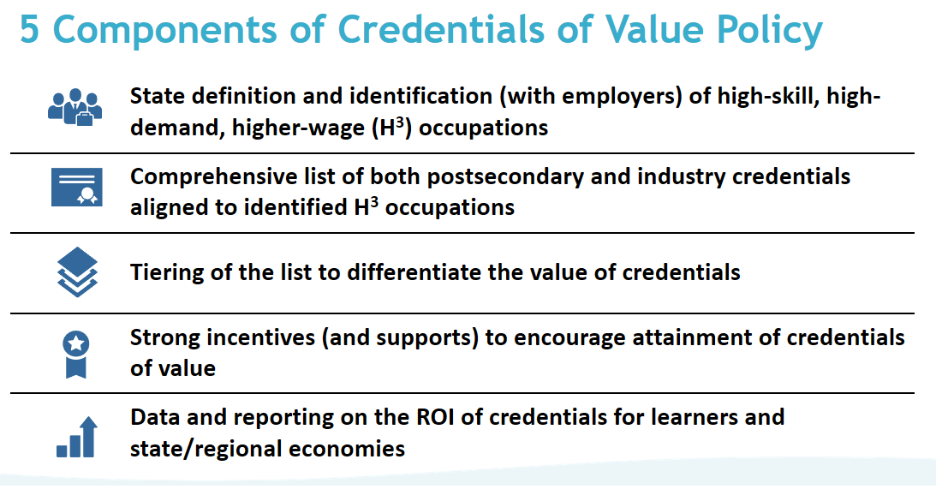
A strong credentials of value policy has five components: state definition and identification of high-skill, high-demand, higher-wage occupations with employers; a comprehensive list of postsecondary and industry credentials aligned to those occupations; tiering of that list to differentiate value; strong incentives and supports to encourage attainment; and data and reporting on ROI for both learners and regional economies.
Two states show what this looks like in practice.
North Carolina’s Workforce Credentials Advisory Council—a partnership across education, workforce development and employers—maintains a list tiered into four categories based on alignment to in-demand occupations, wages and stackability, reviewed biannually, with state law requiring student-level attainment reporting and state funding covering certification exam fees.
Florida’s Master Credentials List is a single unified and tiered list spanning industry certifications, postsecondary certificates and associate degrees, updated at least every two years. Inclusion on the list is tied to state and federal funding.
In contrast, states miss the mark:
Credentials were never meant to stand alone. In a high-quality pathway, a credential is one of four components—paired with job-specific CTE coursework, college credit earned in high school and hands-on work-based learning—providing third-party verification that a student actually gained a skill. A credential detached from that system is a line on a résumé that employers may skip right over.
Workforce Pell puts federal dollars and, more importantly, students’ time behind short-term credentials at unprecedented scale. If states define value rigorously using employer input, tiered lists, meaningful wage and demand thresholds, regular pruning and public return on investment or ROI data, this could be one of the most consequential mobility policies in a generation. If they don’t, policymakers will have built a federal subsidy for credentials to nowhere.
Here are the questions state policymakers should be asking as they implement this program:
Getting the answers to those questions right will determine whether a student earns a credential that changes their life or one that wastes their time.
