Sam Duell is the Policy Director for Charter Schools at ExcelinEd.


School boundaries: Those lines designed to contain and control the mobility of students. Just look at the graphics and data in a recently published Urban Institute piece called Dividing Lines: How School Districts Draw Attendance Boundaries to Perpetuate School Segregation. The report clearly indicates that these lines are drawn to maintain the exclusivity of certain public schools, specifically serving families who buy expensive real estate and pay tuition in the form of property taxes. We know the rules of the game. A better house equals a better school, and a better school equals a safer real estate investment. But did you know that the physical borders between school zones are not the only boundaries families face?
Another new published analysis points to an equally harmful obstacle for families – public charter school enrollment caps. Caps are arbitrary limits on the number of students who may attend charter schools, and these political compromises are designed to protect the traditional public school’s perceived right to children while simultaneously excluding families from real opportunity. The evidence for this is in the enrollment numbers from the 2020–2021 school year.
Charter public schools across the country welcomed more than 230,000 new students in the fall of 2020, while the number of students attending district public schools decreased by more than 1.4 million. That’s according to the analysis released this week by the National Alliance for Public Charter Schools, Voting with Their Feet: A State-level Analysis of Public Charter School and District Public School Enrollment Trends. These two numbers alone are stories in themselves. When the chips were down, many families chose charter schools for the first time.
Not everyone who left traditional public schools in 2020 went to charters. We can see that nearly 1.2 million students went somewhere else. If the numbers from a third recent analysis are believed, many of them did not go to private schools either. They chose to school at home.
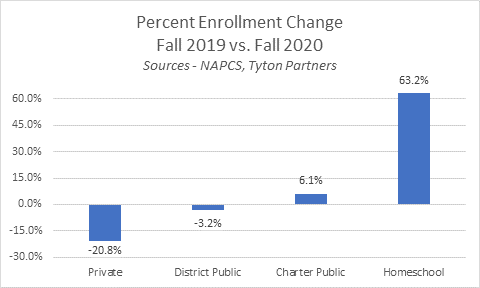
Would more families have chosen a charter school if they lived in state with no enrollment caps? The NAPCS analysis hints at the possibility. Look at Oklahoma. The state stands out in the NAPCS analysis for having the largest growth in charter school enrollment by both percentage gains and by absolute number. The number of new charter students in Oklahoma alone accounts for 15 percent of all new charter students in the nation.
What happened in Oklahoma? Two things: first, the state had full-time virtual charters that were ready to onboard any student who wanted to enroll; and second, the state explicitly prohibits authorizers (oversight bodies) from limiting student enrollment. It’s the second point that I’m highlighting here. Specifically, the statute says an authorizer, “shall not restrict the number of students a charter school may enroll.”
This is a very different state-level policy than in states like Connecticut where charters are limited to 250 students or the equivalent of 25 percent of district’s enrollment, whichever is less. This is a particularly shameful policy in Connecticut because districts lost over 14,000 students in 2020 while charters gained only 134 students. How many of those 14,000 students would have chosen a Connecticut charter school but for a strict enrollment cap?
The same question could be asked of Maine, Massachusetts, New York, Ohio and any state that arbitrarily limits access to charter public schools. New York district schools lost more than 89,000 students last year yet charters only gained 11,700. Would more students have attended New York charter schools if there had been more New York charter schools? It’s quite possible, and I worry that the fear of change or loss compels state leaders to protect systems of schools rather than to fight for families.
When families face huge challenges they don’t wait for solutions. Again, look at the homeschool numbers from the US Census Bureau. Families didn’t wait for policymakers to adjust the boundaries or enrollment caps in 2020. They created their own path forward. Such policies as arbitrary enrollment caps and exclusive school boundaries carry a heavy irony. By protecting a system that limits flexibility and mobility, policymakers encourage families to create their own solutions outside the system, thereby endangering the very system they are trying to protect.
If you think that 2020 was a fluke, a blip on the radar, then think again. Private educational services, ranging from tutoring to private schools, hired more than 40,000 new employees in August 2021. That number accounts for 17 percent of all new hires in all non-farm industries in the nation that month, which is an especially salient statistic when compared with the fact that the number of new hires in state and local government education decreased by 27,000 during the same period. In short, hiring in private education is up, and hiring in public education is down, according to the US Department of Labor.
Policymakers need to let go and follow families. Families are moving with or without the elite decision-makers to make their own way. If policymakers really care about expanding opportunity, they should start by taking a hard look at the obstacles that current policies create in the first place – like those arbitrary enrollment caps on charters and those perniciously exclusive school boundaries. The real way to protect public education is by actively encouraging an educated public. When students thrive, so will their communities.
