Kymyona Burk, Ed.D., is a Senior Policy Fellow at ExcelinEd.


In recent years, a literacy tsunami has swept the lower 48. Educators from Philadelphia to Oakland, California have warned that far too many students are not reading on grade level, limiting their prospects later in life. District leaders have declared a national reading crisis. And states have started to take action by helping educators use the science of reading in their classrooms.
Far from the national media spotlight, a wave of support for strong literacy practices is also building in Alaska. It started gaining momentum a decade ago, Debra Vandyke took over as principal of the Fort Yukon School. Working in the Yukon Flats school district, where nearly all students are Alaska Native and the majority are economically disadvantaged, Ms. Vandyke built support among parents and students for a new push to ensure every student learned to read.
She met weekly with teachers to monitor students’ reading progress and identify gaps. She set aside 90 minutes for reading each day and told the whole community that hour and a half was sacred. She knew that teaching every student to read by third grade would be critical to her school’s success.
“It is so hard to play catch-up if students are not at that level as they progress through their schooling years,” she says.
That sense of urgency is fueling the growing movement to ensure every Alaska student learns to read by third grade. On April 29, Alaska educators will have an opportunity to join that movement. The Alaska Department of Education is hosting a three-day Reading Symposium where attendees will learn how educators across the country are improving their literacy instruction. One weekend could make a lifetime of difference for the nearly 75 percent Alaska students who currently read below grade level.
Alaska leaders want to make sure children in their state aren’t left behind. Here are four reasons why every educator in the state should attend:
Mississippi started requiring teachers to learn the science of reading in 2013. By 2019, the Magnolia State led the nation in fourth grade reading improvement on the National Assessment of Educational Progress (NAEP), making dramatic gains while national results stagnated.
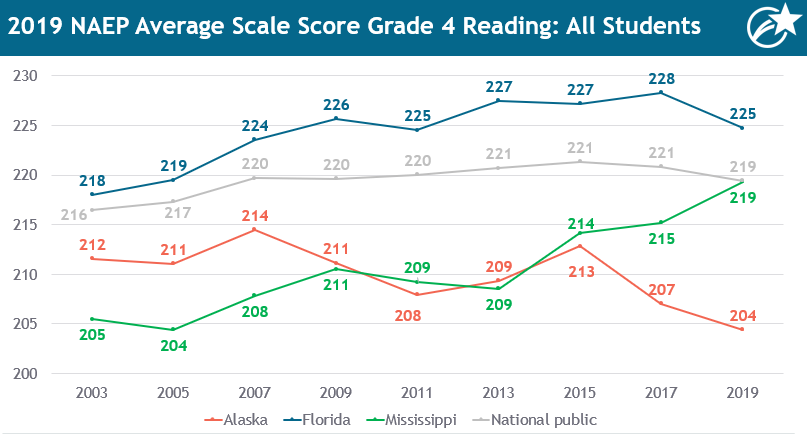
Effective reading instruction depends on effective support for educators.
In Teaching Reading Is Rocket Science, Dr. Louisa Moats writes: “It is possible to teach most students how to read if we start early and follow the significant body of research showing which practices are most effective.”
She also writes: “Reading and language arts instruction must include deliberate, systematic, and explicit teaching of word recognition and must develop students’ subject-matter knowledge, vocabulary, sentence comprehension, and familiarity with the language in written texts.”
According to the Annie E. Casey Foundation, students who are not reading proficiently by the end of third grade are four times more likely to not graduate from high school.
Sessions at the symposium will be facilitated by dynamic leaders and effective practitioners from across the country who are implementing the science of reading in their states, schools and districts. Proven literacy leaders, including Mississippi state education chief Carey Wright and Carol Tolman, co-author of the Language Essentials for Teachers of Reading and Spelling (LETRS) professional development system, will deliver keynotes.
As Debra Vandyke, the former Yukon Flats principal, says, “If students are not reading, are not proficient by the end of the third grade, that has a far-reaching impact on their education. By the time they get to fourth grade, they should already have those skills, because the work will just get harder and harder because it requires so much more reading at a higher level.”
Now is the time to join the movement of educators working to ensure every student has the essential foundation for educational success.
