Christy Hovanetz, Ph.D., is a Senior Policy Fellow for ExcelinEd focusing on school accountability and math policies.


In 1992, toymaker Mattel released a “Teen Talk” version of its ubiquitous Barbie doll. Equipped with a tiny voice box, each doll randomly repeated four pre-programmed phrases from hundreds the company had scripted for the dolls.
One short sentence uttered by Barbie, “Math class is tough!” quickly generated headlines and lots of criticism. While it didn’t take long for Mattel to eliminate the phrase, the misconception persists—not because math is tough, but rather because learning math requires time and practice.
It’s a good thing Barbie ditched that negative attitude more than 30 years ago. In her recently released movie, Barbie is transported from her perfect Barbie world into the real world. And it’s a 21st-century world where math is essential. She’d have a tough time without math skills!
Yet too many students dismiss their ability to achieve in math. The National Mathematics Advisory Panel Report offers an explanation why:
“Research demonstrating that beliefs about effort matter and that these beliefs can be changed is critical. Much of the public’s resignation about mathematics education (together with the common tendencies to dismiss weak achievement and to give up early) seems rooted in the idea that success in mathematics is largely a matter of inherent talent, not effort.”
This is encouraging! It means that with effective instruction, coupled with practice and effort, student math achievement will improve.
Barbie’s mid-career attitude shift about math has served her well. For instance, it allowed her to job-hop…a lot! Ever since starting her career as a fashion model back in 1959, Barbie has had over 200 different careers. Nearly all of them required math knowledge and skills—even “non-math” jobs like campaign fundraiser, chef and entomologist. Some of her other jobs required math degrees, like astrophysicist, game developer and robotics engineer. In a sense, maybe every Barbie is a Math Barbie!
Surprisingly, even after 64 years in the workplace, Barbie doesn’t seem to be any closer to retirement. Perhaps her early-career attitude about math hindered her financial literacy and fiscal planning? Or maybe it was her let’s-go-party lifestyle that’s keeping her working for a paycheck. Surely, her blockbuster movie revenues this summer can get her finances back on track. Good thing she’s now very skilled in math!
Follow the findings from the National Mathematics Advisory Panel Report, outlined in ExcelinEd comprehensive K-8 math policy, to ensure all students are well prepared to be transported from K-12 classrooms into the real world. Research shows that mastering early math skills is a predictor of on-time graduation, career attainment and positive later-in-life outcomes.
Did you know?
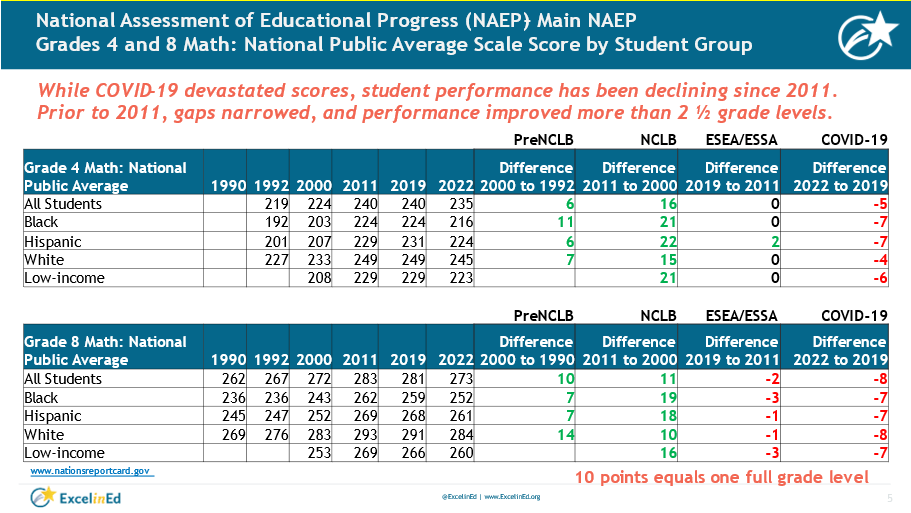
All kids can do math. In 2011, fourth- and eighth-grade students nationwide were scoring two and three grade levels better in math than their 1990 peers on the National Assessment of Educational Progress (NAEP). They even narrowed achievement gaps! But progress has slowed in recent years. Rigorous expectations and being more accountable for math student outcomes can restore that awesome trend.
