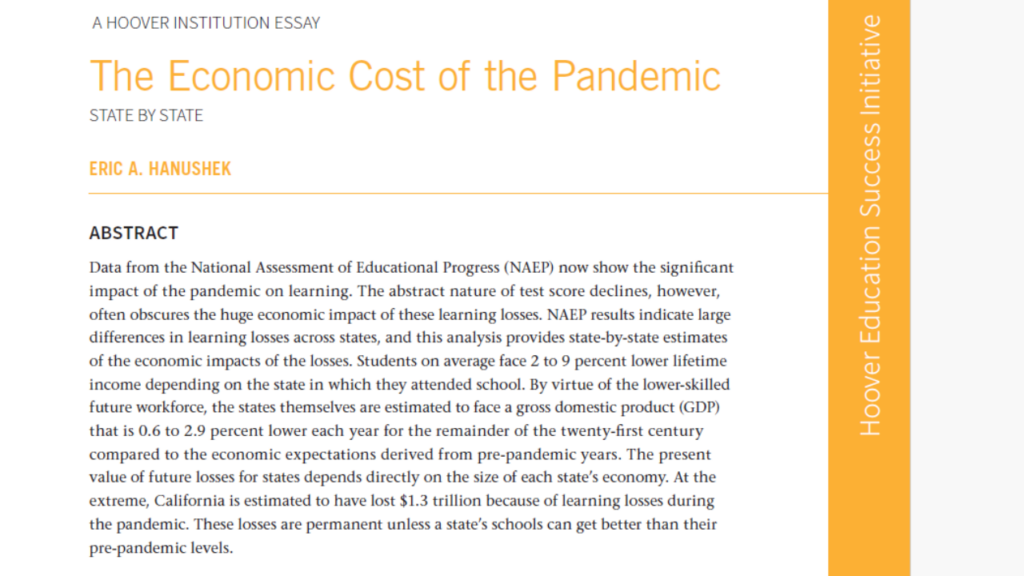
On Friday, Dec. 8, ExcelinEd and the Organisation for Economic Co-operation and Development’s (OECD) hosted a virtual rollout of the 2022 Programme for International Student Assessment (PISA) math results, focused on the U.S.
The Hoover Institution’s Dr. Eric Hanushek joined the event to present his 50-state analysis of the PISA math results and the economic cost of math declines. This is the first set of international data on math performance post-COVID.
Attendees gained insights into how the U.S. is performing in math compared to other countries across the world, how individual U.S. states are performing, and policy solutions that can transform math instruction and performance and lead to rising student achievement.
Success in mathematics education is vitally important for all students. It gives them college and career options, increases prospects for future income and improves outcomes later in life.
Unfortunately, there are not quick fixes. A comprehensive K-8 mathematics strategy includes daily math instruction with high quality content and instructional materials; support for teachers; assessments and parent notification; interventions; and resources for families and caregivers.
K-8 Math Policy: Comprehensive Model Policy
K-8 Math Policy: It Adds Up To Algebra I Readiness
K-8 Math Policy: Instruction and Departmentalization Model Policy


This practice guide provides evidence-based practices that can help teachers tailor their instructional approaches and/or their mathematics intervention programs to meet the needs of their students.

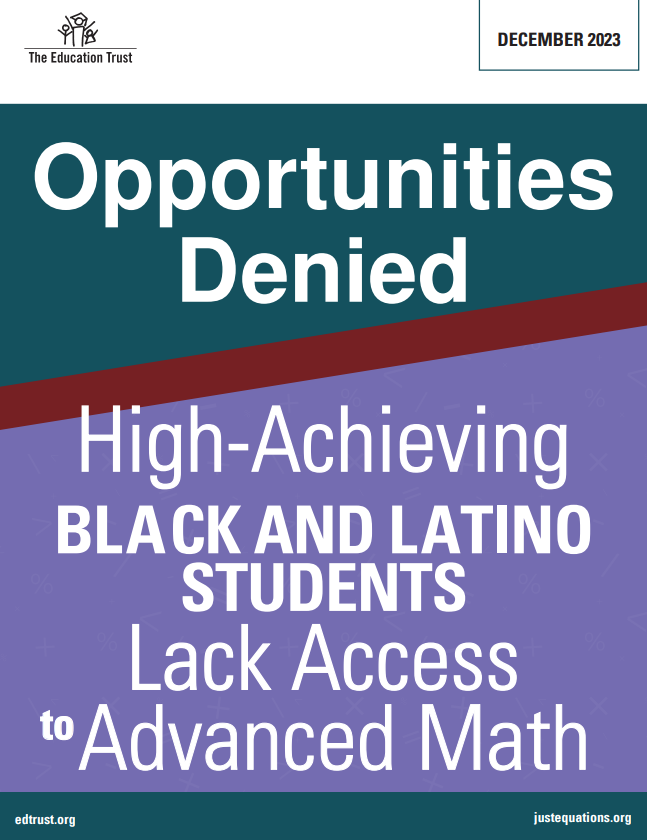
For this brief, The Education Trust and Just Equations partnered to explore differences in patterns of math course enrollment for high school students using data from students who participated in the 2009 High School Longitudinal Study (HSLS:09). Like other research has shown, we find that high-achieving Black and Latino students and students from low-income backgrounds who take and pass Algebra I in eighth grade still end up taking advanced math courses in high school at lower rates than their peers.
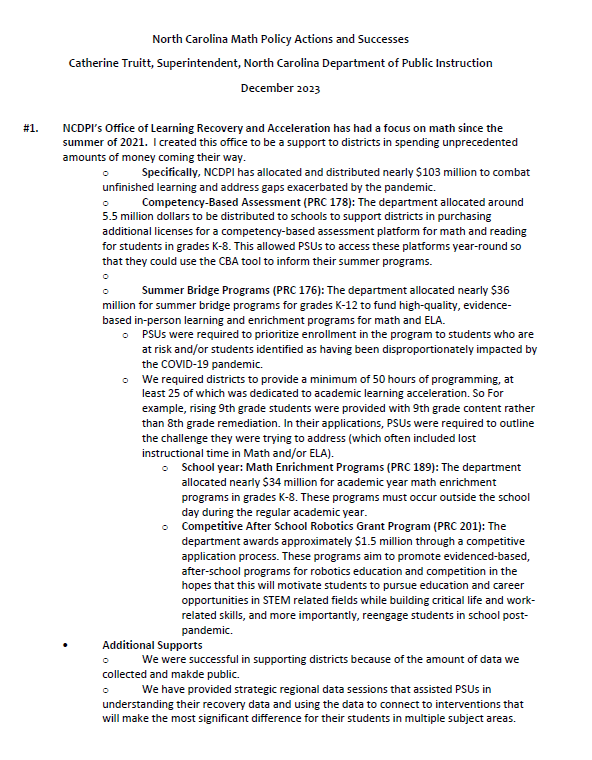
NCDPI’s Office of Learning Recovery and Acceleration has had a focus on math since the summer of 2021.
Currently, our focus is on the legislative short session this spring. We want to ensure that every NC student is proficient in Algebra I.
NC is the recipient of a new USED Education and Innovation Research grant designed to improve math outcomes for high-needs students.

Three big ideas to stress:
Fractions
Fluent use of a number line to represent fractions, add and subtract them, compare magnitude of all types of numbers.
Word problems and problem-solving