

School may be out for summer, but new data just came in showing incredible results for charter schools that make a clear case for policymakers that public school choice is working—especially for students who most need quality options.
Last week, the Center for Research on Education Outcomes (CREDO) at Stanford University released its third national study on charter school academic progress. Overall, charter school students had an additional 16 days of learning in reading and six days of learning in math compared to their traditional public-school counterparts.
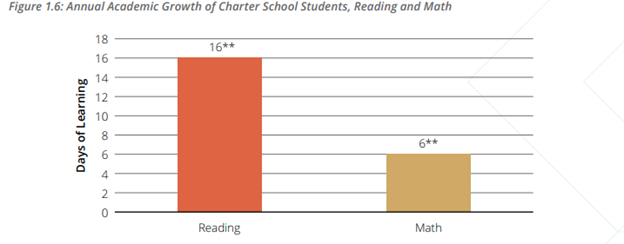
Those results on their own are remarkable, but perhaps most important for the public policy debate about charters are data showing they have disproportionately helped low-income and minority students.
What’s more, we know this success is compounded over time. The longer a student is in a charter school, the more additional learning will take place. By their fourth year in a charter school, students show 45 days of stronger growth in reading than their traditional public school peers and 39 additional days of learning per year in math. This growth is attributed to the instruction students receive at that school.
We also know from the study that these successes can be scaled. Charter management organizations (CMO), groups which oversee charter schools across multiple campuses, performed even better than their single-site peers.
Students attending CMO schools gained the equivalent of 27 additional days of reading learning and 23 additional days of math learning per 180-day school year. Students attending the stand-alone charter also made statistically significant gains in reading (+10 days) but broke even with their traditional public school peers in math.
Perhaps the most impressive finding in the CREDO study is that more than 1,000 charter schools have eliminated achievement gaps for students attending their schools and moved their achievement ahead of their respective state’s average performance. Several CMOs have eliminated them across multiple schools in their network, a feat demonstrating scaling and replicability. We should laud these results and encourage their growth.
These findings, coupled with the national growth of open-enrollment policies, offer a one-two punch for public school choice policies, which are designed to ensure access to a quality education is available to all and helps meet the needs of the individual student. We know there is still work to do among certain sub-groups–SPED students had weaker growth (13 fewer days in reading and 14 fewer in math).
The bottom line: Charter schools positively change the lives of their students, and we are excited by these findings. We will continue to work to educate others about policies that unleash the potential of the charter sector, including policies that allow charters to have easier access to facilities that allow educators to meet the needs of their students. Now is the time to continue to eliminate policy barriers that allow charters to grow and thrive because they are truly making a difference for their families.
