Sonya Yates is the Associate Policy Director for Literacy for ExcelinEd.


“It’s a disgrace that you have to be ‘lucky’ to learn to read.”
“Parents who can’t afford outside tutoring are left at the mercy of the district’s curriculum.”
“It shouldn’t be a miracle for a child to learn to read.”
Hard words to read, but the truth for too many.
The most recent National Assessment of Educational Progress, our Nation’s Report Card, indicates that 66% of fourth graders in the United States are failing to achieve reading proficiency. There may be a variety of reasons for why some students struggle to become skilled readers by fourth grade, but Dr. Sally Shaywitz, co-founder and co-director of the Yale Center for Dyslexia & Creativity, reports that one in five students is impacted by a specific reason for that struggle: dyslexia.
While some states have adopted comprehensive literacy policies aimed at positively impacting student reading outcomes, disparities in adequate funding, targeted support for students with learning differences and effective implementation remain. One way to help close the reading achievement gaps our nation faces is to adopt and effectively implement a dyslexia education policy to identify and meet the needs of these unique learners.
Most people know someone with dyslexia. It is the most prevalent and least understood reading disorder. The word “dyslexia” means difficulty (dys-) with words (lexia). Rudolf Berlin coined the term “dyslexia” in 1883 but mistakenly defined it as a visual disorder. This misconception has had a lasting impact on the public’s understanding of dyslexia and fostered myths that still abound.
The definition was revised in 1994 and again in 2002 to more accurately reflect that dyslexia is a language-based learning difference. It’s characterized by slow, inaccurate reading, along with poor spelling and poor writing skills—even though many people still associate dyslexia with just reversals of letters or words. In education settings, a lack of awareness of the true nature of dyslexia makes it difficult to identify and provide students with the services they need to overcome reading challenges.
Since 2015, advocates for supporting students with dyslexia have worked to foster awareness of the challenges some students face through their campaign #SayDyslexia. Yet it is equally important to have systems and resources in place to meet the needs of students as soon as they are identified. Dyslexia advocacy groups such as Decoding Dyslexia have been instrumental in changing policies in states to include a definition of dyslexia, teacher training, early screening and intervention for students identified with dyslexia characteristics. However, there is still a lot of work to do to reach all stakeholders.
Well-written education policy is the foundation for effective implementation. While some states are working to overcome the action gap, others still need to overcome the policy gap. Policy gaps occur when legislation is not comprehensive enough to spur change. Gaps also exist between legislative intent and the guidance needed to ensure effective implementation. For example, a policy that requires dyslexia screening—but fails to provide structured literacy training for teachers to deliver dyslexia-specific interventions—creates a gap between expectations and outcomes.
States began passing dyslexia laws in the 1980s, yet with little or no funding and accountability, implementation of those laws has not led to greater support for dyslexic students. Several factors that have contributed to decades of incoherent and ineffective policies, and these have created issues that must be addressed as states delve into dyslexia policy. Here are options to turn things around:
Dyslexia education policy must address the lack of knowledge and understanding among many educators. It has long been a complaint of both parents and advocates that teachers do not understand dyslexia. In fact, some teachers would agree that they have had insufficient training in supporting students with dyslexia.
Only 14 states require teacher education programs to include dyslexia in their content, and 21 states require professional learning to be offered to in-service teachers. Louisiana and Alabama, for example, provide funding for teachers to complete dyslexia therapy training, while Mississippi and Alabama provide stipends to teachers who have earned a national certification in dyslexia therapy.
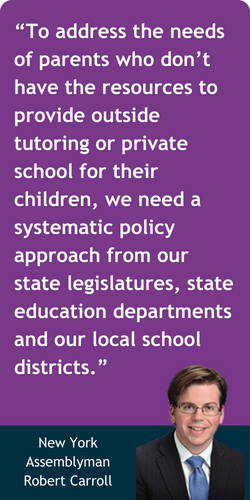
In New York, Assemblyman Robert Carroll, who struggled with reciting the alphabet or spelling his name in first grade due to dyslexia, has sponsored four pieces of legislation: The Dyslexia Task Force Act; The Right to Read Act; The New York Individuals with Dyslexia Act; and the Dyslexia Diagnosis Act. He has been quoted saying that “[t]hese bills, when passed, will ensure every child in New York, no matter their income, will receive a structured, sequential, cumulative phonics-based reading education and a pathway for schools to screen, diagnose and provide appropriate interventions for children struggling with dyslexia.”
While more states have begun to adopt and implement dyslexia policies, it has been a case of too little too late for some students.
As a result, many parents have been forced to seek external dyslexia supports such as assessments, tutoring or private school for their children. These external supports typically come at a high cost and are not accessible to everyone. Fortunately, some states are investing in systematic changes to education policy that benefit all students, including those with dyslexia.
One of these is school choice. Choice provides parents with options to place their child in the most suitable learning environment with teachers equipped to meet that child’s needs. States that allow parents to use state funding to pay for private schools have seen an increase in private schools serving students with special needs, including dyslexia.
In the public sector, specialty charter schools for students with dyslexia are also continuing to grow across the nation. A decade ago, Dr. Laura Cassidy and Suzanne Petty, parents of dyslexic children, saw the gap in resources and support systems and founded Louisiana Key Academy in 2013, which has recently expanded to three campuses.
Dr. Cassidy has shared her perspective that just as a physician with 20 cancer patients would never make a blanket treatment plan for them, we need to be sure that we are being diagnostic and prescriptive in education as well. When dyslexia is identified, teachers must have the proper training and materials to ensure the needs of our students are met. It is a disservice to students, parents and teachers for us to do anything less.
As more and more states pass early literacy policies, those policies must be strong enough to reach all students, including those with dyslexia or other reading-related disorders. Furthermore, passing a policy that does not include funding and accountability only leads to inaction, which leads to frustration for families, students and educators. Simply defining dyslexia along with a #SayDyslexia campaign are no longer enough.
Policies with impact will include educator training in structured literacy; mandatory dyslexia screening; parent notification of results; and dyslexia-specific interventions, all supported by the necessary funding for implementation. For decades, students with dyslexia have been left behind or overlooked. It’s time to work together and persevere until all children receive effective literacy instruction and an equitable opportunity to learn to read.
To learn more about how to raise awareness in your community, check out the International Dyslexia Association’s website.
ExcelinEd’s Dyslexia Model Policy
ExcelinEd’s Dyslexia Policy Brief
State Dyslexia Laws – Dyslegia: A Legislative Information Site
State of Dyslexia | National Center on Improving Literacy
Dyslexia Resources – Dyslexia On Demand
Dyslexia Legislation Interactive Map – International Dyslexia Association (dyslexiaida.org)
Understanding Dyslexia: Myth vs. Facts | National Center on Improving Literacy
