Christy Hovanetz, Ph.D., is a Senior Policy Fellow for ExcelinEd focusing on school accountability and math policies.


Did you know July is National Anti-Boredom Month? That’s the designation public relations guru Alan Caruba gave it back in 1980, because he wanted people to stop moping around and focus on other things in life.
Even though there’s never a boring month working in education policy, many of us have heard those words uttered by others—for example, kids on summer break from school.
What can be done to alleviate that boredom? The Mayo Clinic reports that “spending time with nature is one of the best therapeutic ways to ward off boredom. It also promotes creative thinking.”
Once you’re outside, there’s a lot of math to think creatively about.
Many naturally occurring shapes and phenomena in nature can be explained mathematically. In fact, these same mathematical explanations are often used to construct devices.
Here are examples of what you might find when you walk out the door into the realm of the un-boring: Honeybees dominate geometry with their efficient hexagonal honeycombs. Many tree leaves have bilateral symmetry. Concentric circles, which appear in tree rings, spider webs and water ripples that accompany a thrown rock, all have the same center, but different radii.
By far my favorite finds in nature are fractals and Fibonacci sequences.
Fractals are endless patterns that start simply but quickly become complex. The repeating shape creates intricate shapes with an infinite perimeter, but the entire fractal remains in a finite area.
The Koch snowflake is a popular example of a fractal. This fractal is created using an initiator, the starting shape, which is an equilateral triangle in the Koch snowflake. A generator is an arranged collection of scaled copies of the initiator. In the Koch snowflake, the first generator is the smaller scaled equilateral triangle centered on each side of the initiator.

There are many interesting real-life application of fractals. These include image compression and resolution, antennas, art and medical diagnosis. In medicine, doctors have found that healthy blood vessel cells grow in orderly fractal patterns, but cancer cells do not. The abnormal pattern allows for a diagnosis.
A Fibonacci sequence, named after medieval Italian mathematician Fibonacci, describes certain shapes that appear in nature, called logarithmic spirals. They can be seen in incredibly diverse places, such as Nautilus shells, sunflower seed faces, unfurling ferns, curled elephant trunks, hurricanes, pinecones and more.

The spiral is based on a specific numerical sequence that begins like this: 0, 1, 1, 2, 3, 5, 8, 13, 21, 34, 55, 89, 144, 233, 377, 610 and 987—where each number is the sum of the two previous numbers. The spiral is then created when connecting the opposite corners of each new square.
Number theory, algebra and geometry use Fibonacci sequences to enhance problem solving and increase efficiency. They are used in computer science and data analysis to create efficient and accurate algorithms for searching and sorting. They also can model complex relationships between variables; enhance machine learning and AI; and analyze financial markets and trading by creating price goals for buying and selling stocks.
There’s nothing boring about any of that!
If you’re still plagued by summertime ennui, try going outside to observe math, solve the Rubik’s Cube, watch a math movie or read ExcelinEd’s comprehensive K-8 math model policy based on fundamental principles from the National Mathematics Advisory Panel – a sure cure for boredom and improving student math outcomes.
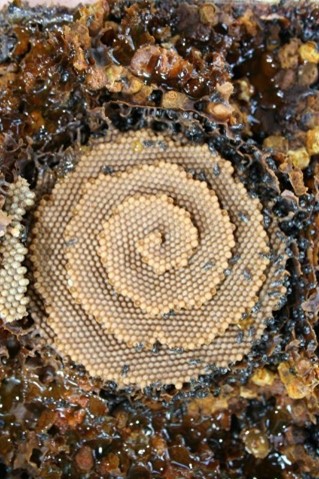
Naturalist Charles Darwin declared the hexagonal honeycomb made by bees “absolutely perfect in economizing labor and wax.” That’s because hexagons use the least number of separating walls to cover flat surfaces, so bees prefer them because they use less wax. Some believe that bees also use the Fibonacci sequence, because the number of cells in each row of a honeycomb is frequently a Fibonacci number.
