Christy Hovanetz, Ph.D., is a Senior Policy Fellow for ExcelinEd focusing on school accountability and math policies.


Bonjour! The world’s top athletes are competing in a variety of physical pursuits this week as Paris hosts the 2024 Summer Olympics from July 26 to August 11.
We’ve already seen some remarkable games, performances and races.
U.S. swimmer Gretchen Walsh, competing in her first games, set a new Olympic record during the women’s 100-meter butterfly semifinals. Walsh clocked in at 55.38 seconds, besting the record of 55.48 set by Sarah Sjostrom at the 2016 Rio games by 0.1 second. Walsh ultimately earned a silver medal in the finals, finishing just 0.04 seconds behind fellow American Torri Huske. She now holds both the Olympic and world (55.18 seconds) records in this event.
But have you ever wondered why Olympic records are regularly bested? How do athletes keep getting better, faster and stronger?
Since 1896, with the advent of the modern-day Olympics in Athens, the time for the men’s marathon, for example, has decreased by more than 50 minutes. Other than in 1904, when the St. Louis games featured an ill-planned course, heat, limited hydrating stations and (literally) a pack of wild dogs, marathon times have trended faster.
Why?
You guessed it: math.
Elite sports programs use biometric data, mathematical equations and statistics to continuously analyze athletes’ performance to make adjustments that will give them an edge over the competition.
Olympic marathoner Jared Ward is an example. His day job as a statistics professor at Brigham Young University gave him a leg up in Rio’s 2016 games, where he finished sixth. Ward’s research in sports statistics, optimal pace strategy and performance curves helped him move from college athlete to fulfilling his Olympic goal of finishing in the top 10. His research can benefit runners of all levels.
Ward, along with his colleague, Iain Hunter, analyze marathon runners’ data to better understand performance trends. Using biometric data, they can analyze how to make a particular runner’s body movements more efficient, advise on customized strength training activities, recommend optimal pacing and mile split times and even estimate the runner’s needs for nutrition and hydration based on energy spent.
These data—plus on-site information about weather (heat, humidity, wind), course terrain (inclines, declines, elevation) and the runners themselves (age, weight, gender)—are used to determine the best strategy for each athlete.
Math is also used to calculate the ideal trajectory of the course to ensure the shortest route. For example, taking the inside curve and not running around other runners eliminates unnecessary distance.
Athletes and their trainers aren’t the only ones who rely on math. Engineers and scientists use it to design the sports equipment used in pursuit of excellence. For runners, recent innovations in shoe technology reduce energy loss when the foot strikes the ground to improve running economy.
This week, check out the 2024 Olympic marathon races for men and women on August 10 and 11 to observe math in action. You can appreciate the training support, which includes mathematicians, statisticians and scientists, that goes into these athletes’ success.
And during commercial breaks, be sure to read ExcelinEd’s comprehensive K-8 math model policy based on fundamental principles from the National Mathematics Advisory Panel. These policies are sure to enhance student math outcomes in the long run.
Even before this year’s games began, Team USA has dominated the Summer Olympics in the medal count, winning a total of 2,635 medals in 28 modern games: 1,061 gold, 836 silver and 738 bronze. The second-most successful team in Summer Olympics history, from 1896 to 2020, is Russia (the former Soviet Union) with 1,627 medals.
While I am proud of the athletes representing the USA, the mathematician in me looks at the medal statistics a little differently than the media, which often focuses on total medal counts. When looking at this statistic per capita, the United States has won just under 8 medals per one million inhabitants, ranking us 24th. The Bahamas, Hungary, Finland and Sweden are at the very top, winning 50 or more medals per capita! The Soviet Union ranks 36th, winning fewer than four medals per capita.
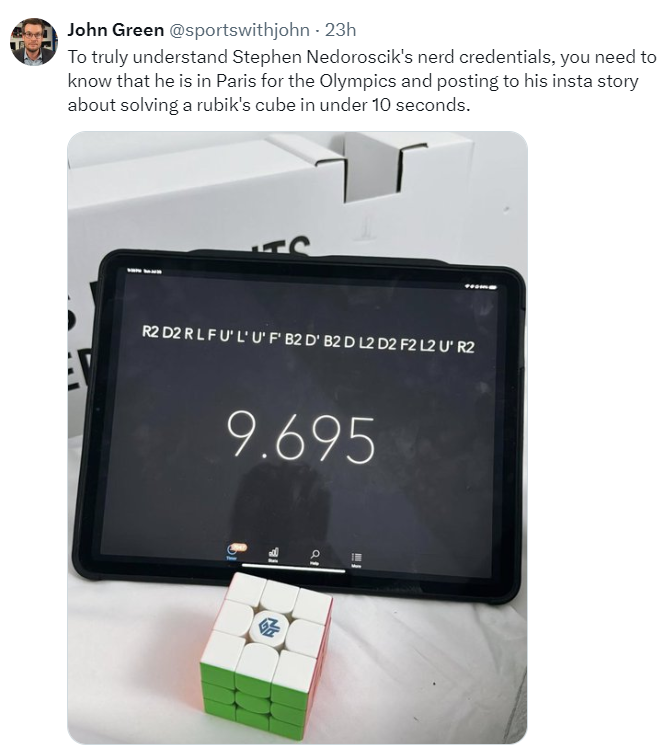
In June, we shared the history of the Rubik’s Cube and its influence on math. While waiting nearly three hours to compete in his only event during the men’s gymnastics team competition, Stephen Nedoroscik—now known to the internet as the “Pommel Horse Guy”—passed the time with his Rubik’s Cube.
He didn’t quite hit the world cubing record of 3.13 seconds, but he solved the puzzle in under 10 seconds before helping the team secure their first medal in 16 years.
