Ben DeGrow is a Senior Policy Director of Education Choice for ExcelinEd.


No one understands the limitations of one-size-fits-all schooling better than parents. While the expansion of educational choice over the past three decades is helping more students find new opportunities, many families still struggle to find the right fit for their children.
Families seek everything from safer learning environments to increased academic rigor to specialized programs to alignment with personal values, all of which reflect the broad diversity of student needs and underscore the importance of state policy in closing the gap between available opportunities and family priorities.
State policymakers can help parents access the high-quality options they want. Currently, most states offer some choice beyond traditional residential zoning, including options for homeschooling and charter schools. But access to broader choices varies widely by state. For example, policies that allow families to enroll their children in schools outside their designated zones or help with private school tuition can still be limited, creating inconsistencies in opportunity.
By enacting policies that support diverse schooling models, policymakers play a critical role in shaping the school choice landscape. In short, policy decisions help unlock the potential for educational choice to meet a greater range of student needs.
In order to potentially break down more barriers to choice for families, we must first understand the landscape, which differs from state to state based on several factors.
At ExcelinEd, we live by the mantra “policy changes lives,” and we know that school choice comes in many forms. There are many organizations that work in this space, often focusing on just one piece of the puzzle. We wanted to take a broader view, showing policymakers what is happening in their states and others so they can make needed changes.
Our school choice team spent the past year researching what states have on the books in 40 different school choice-related policy areas. That research is the backbone of our new online resource, School Choice Matters, which provides both a quick look at how well each state is meeting the mark for each of those policies and a deeper dive into the ecosystem within a state.
Most of the core policies we looked at fit into one of four main buckets: open enrollment, charter schools, private school choice and homeschooling. The rest we refer to as “policy enhancers,” areas like part-time enrollment and transportation that can enhance student access to the other options. Together, they form an ecosystem of choice policies that have a real impact on the lives of students and their families.
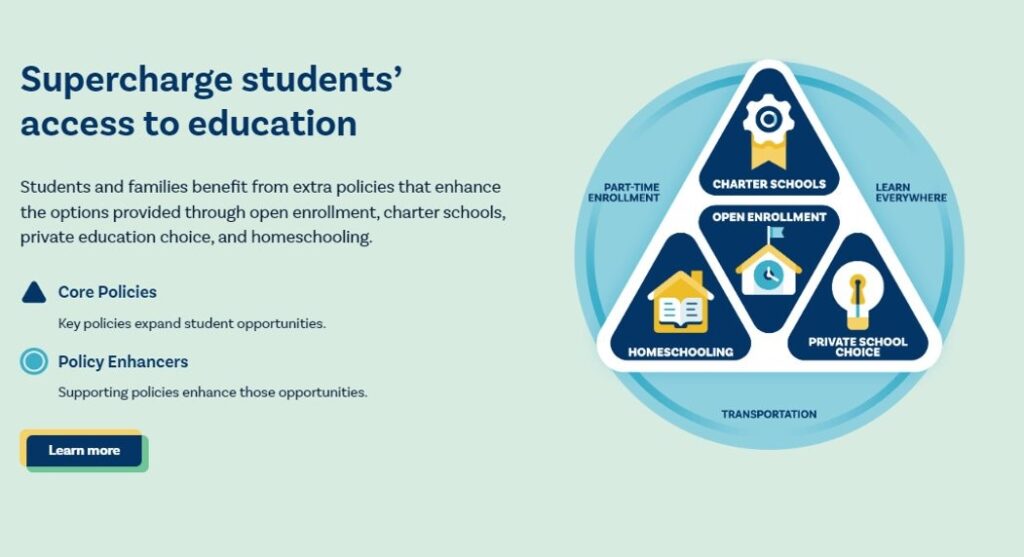
Public school choice is the most pervasive form of education choice across the country, as nearly all states offer some options for families to navigate within the public school system. A student’s zoned public school might not be their best fit, but they still want to take advantage of everything public schooling has to offer. Two of our four core policy areas focus on public school choice.
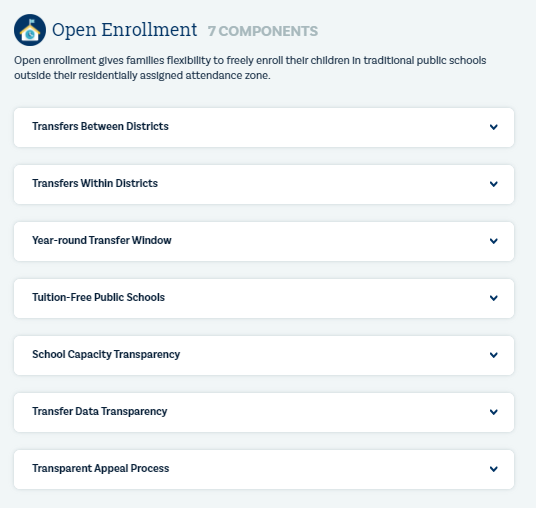
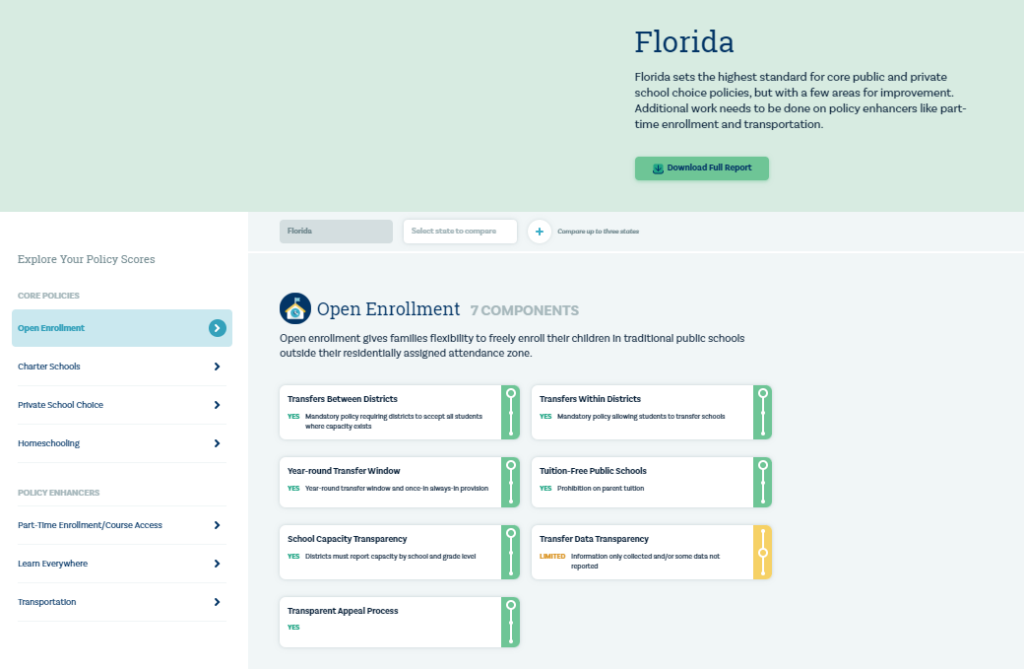
The first is open enrollment, which gives families flexibility to freely enroll their children in traditional public schools outside their residentially assigned attendance zone. Strong open enrollment policies mean that public schools should be open to all students tuition-free and on a year-round basis. They also include a transparent appeals process for students whose transfer requests have been denied. Each of the criteria aims to provide more opportunities for students, along with the share of dollars set aside for their education.
This section is broken down into seven policy components.
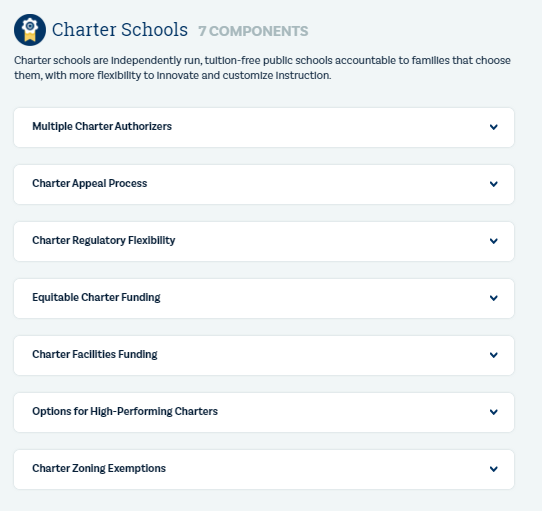
The second policy area that falls within public school choice is charter schools, which are independently run, tuition-free public schools accountable to families that choose them and authorizers that chartered them, with more flexibility to innovate and customize instruction.
School Choice Matters values different criteria for healthy charter schools, including multiple authorizers and flexibility from regulations. Funding should also treat charter school students equally with their traditional district peers.
This section also includes seven policy components.
Private school choice offers state funding or tax incentives to help families pay for tuition at a private school where they choose to enroll their children and possibly pay for other education expenses as well.
Most states offer one or more programs that fund tuition payments or help cover other important education services if they’re not enrolled in a public school. The first seven School Choice Matters ratings under this category apply to all kinds of private school choice, crediting states for making more students eligible, funding them fairly, giving families easy access and not overregulating schools and providers.
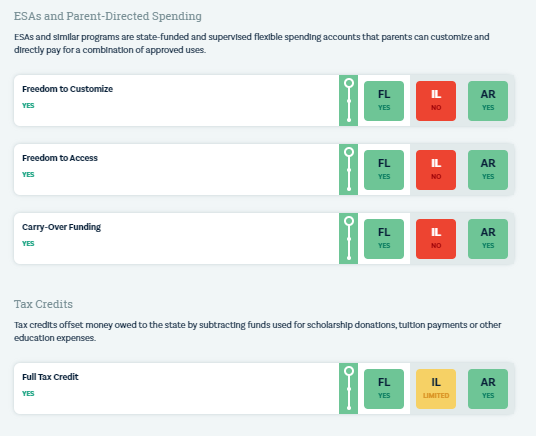
Even better than traditional voucher programs, which only underwrite a family’s school tuition costs, are education scholarship accounts. School Choice Matters assigns higher marks to states that give parents more spending flexibility and the ability to carry over funds for future expenses. States that finance private choice through tax credits rather than direct state funding can only earn a green rating by rewarding scholarship donations or other education expenses with full dollar-for-dollar credit.
The private school choice section of our website rates states on 11 policy components.

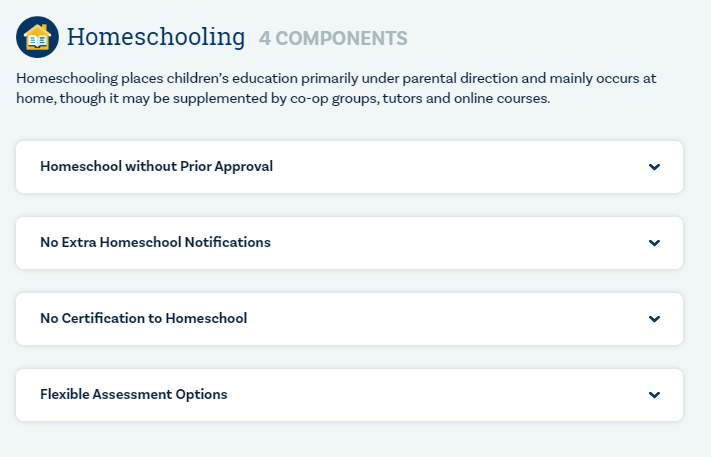
The last core policy category we analyze on School Choice Matters is homeschooling, where a child’s education is primarily under parental direction and mainly occurs at home, though it may be supplemented by co-op groups, tutors and online courses.
We graded states on four different homeschooling policy components.
Beyond the four core policy areas, we analyzed policy enhancers that further provide flexibility for students to find and schools to deliver additional options for families. This section covers three distinct buckets:
Policymakers and stakeholders can use School Choice Matters two ways: to gain a national perspective on a particular policy or to dive deep into one state and find out how many school choice policies they have put in place.
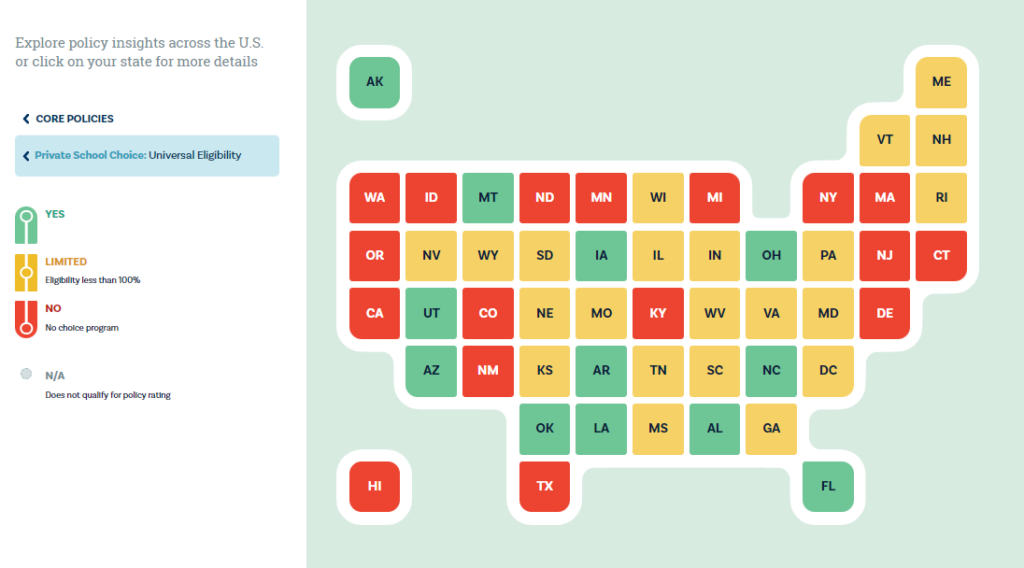
For example, if you want a quick look at how states rate on universal eligibility for private school choice programs, you can use the national map this way:
If you’re looking to find out how your state is doing in all 40 policy areas, you can display all of the ratings on one page.
There’s also an option to compare policies in up to three states at a time.
If you’ve got some extra time and intellectual curiosity, you can read through one or more of our deep-dive state reports to explore references to the original sources. To get a flavor for it, click on the state where you live and download a report to see what details can be gleaned. Users can better see what the statutes and rules say to understand the basis for the rating.
Beyond ways to look at how states are doing in the 40 school choice policies, the website includes a glossary of school choice terms and some frequently asked questions about educational choice.
A separate citations page connects to other important online documents and data, which come both from ExcelinEd as well as some other trusted partners, that were used in the research. Finally, scrolling down the home page will lead to a handy list of key resources that could be bookmarked for future reference.
School Choice Matters is accessible and easy to use, not only on a laptop or desktop, but also on smartphones and other mobile devices. If you have any questions or feedback about the resource, please contact one of our school choice subject matter experts, listed at the bottom of this page.
