Abby Burrola is an Associate Director of Education Policy at ExcelinEd.


When it comes to school choice, the goal is simple: ensuring that every child has access to a learning environment that meets their unique needs. Public and private school choice programs both aim to expand educational opportunities, but they do so in different ways.
Public school choice generally refers to options such as charter schools, magnet schools and open enrollment policies that allow families to choose public schools outside their residential zones.
Private school choice includes programs like vouchers, tax credit scholarships and education scholarship accounts (ESAs), which provide families with the resources to afford private school tuition or other educational expenses.
Policymakers sometimes express concerns that expanding one type of choice may come at the expense of the other, potentially creating competition between public charter schools and private school choice programs. However, evidence suggests that these options can not only coexist but thrive simultaneously, offering a broader spectrum of opportunities for families.
Let’s explore how this dynamic plays out in four states with robust school choice landscapes where parents have had access to different schooling types for years: Florida, Arizona, Indiana and Ohio. Data for these state snapshots has been sourced from the EdChoice Share.
Florida leads the nation in school choice with some of the most robust programs that have grown steadily since they began a quarter-century ago. Today, nearly half of Florida students attend a school other than the one to which they are residentially assigned.
While private school choice programs have expanded significantly, becoming fully universal two years ago, charter schools continue to enroll more students overall. This dual growth is a testament to Florida’s strong policies supporting charter school funding, flexibility and expansion.

Arizona’s universal ESA program has led to a surge in private school choice participation, but charter schools remain a popular option for families. Charter schools still enroll more students than the state’s ESA and tax credit programs combined thanks to Arizona’s strong charter school law, which provides ample funding and operational flexibility. This balance highlights how a state can offer a diverse array of choices without diminishing either sector.

In Indiana, both charter school enrollment and private school choice participation are on the rise. Since the expansion of Indiana’s voucher program to include a broader range of students, private school choice has grown at a slightly faster rate than charter schools. However, the steady growth in both sectors indicates that families are finding value in having multiple options to meet their children’s needs.

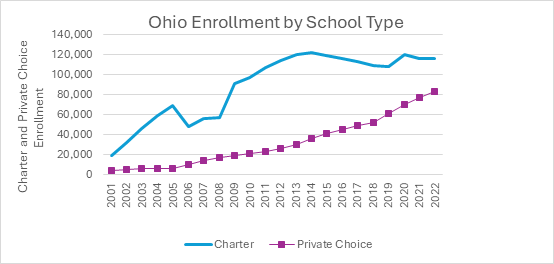
Ohio’s charter school enrollment has plateaued even as private school choice participation sees modest growth. Among the four states examined, Ohio provides the least funding and operational flexibility for charter schools, which likely contributes to this stagnation. Despite this, charter schools in Ohio still enroll more students than the state’s private school choice programs, underscoring the importance of supportive policies to ensure growth across both sectors.
As policymakers consider the future of school choice, it is essential to recognize that families are not seeking one-size-fits-all solutions. They deserve a healthy, robust ecosystem with both public and private options they can access to best meet the needs of their children.
Expanding choice in one area does not have to come at the expense of another—instead, it can enhance the overall educational landscape, empowering families to make the best decisions for their children.
The data from Florida, Arizona, Indiana and Ohio show that public and private school choice programs can complement rather than compete with each other. Policymakers can use these insights to craft policies that promote a balanced approach, ensuring that families have access to a variety of high-quality educational options.
We recently launched SchoolChoiceMatters.org, a powerful new resource designed to support policymakers with a comprehensive national look at how school choice policies have been enacted at the state level.
Our school choice team spent a year examining 40 school choice-related policy areas in states across the country. This work culminated in the launch of School Choice Matters, which serves as a dual-purpose tool, offering both a quick snapshot of how well states are addressing each policy area as well as an in-depth exploration of the broader school choice ecosystem within each state.
Check out the interactive map and ecosystem of policies today to learn more about public and private school choice policies in your state.
