Matthew Joseph is a Senior Policy Advisor at ExcelinEd.

As school districts across the nation make their way through their annual budget cycles—the first time in many years they’ve done so without federal pandemic recovery funds—a pressing crisis looms large: declining student enrollment.
For decades, the American public education system has operated with an “if you build it, they will come” mentality, pouring billions into school buildings and staffing with no end in sight. In the coming years, we know that fewer students will walk through those doors, and it’s not a temporary blip. It’s a trend that’s here to stay.
To be clear, this shouldn’t come as a surprise to anyone. There are people who’ve been sounding the alarm on the declining enrollment trend. There are, in fact, people who’ve been talking about it for years.
But the folks who most need to be listening—school districts and community leaders— seem focused on the trees, not the forest. Many are planning for the moment instead of looking ahead to what’s coming and figuring out ways to lessen the financial impact.
The school board in Denver recently decided that no more schools will be closed or consolidated for low enrollment until 2030, though they left open the possibility “if there is a substantial shift in student enrollment, funding levels, or an unexpected emergency.”
In Chicago, there are 70,000 fewer students than a decade ago, and even the best-case scenario only predicts a modest increase from the district’s current enrollment of 325,000 students. The decrease is largely due to falling birth rates, which declined more than 43% from 2011 to 2021. Yet the Windy City continues to operate aging, expensive school buildings with low attendance with seemingly no plan to mitigate the financial costs.
A recent study from the Brookings Institution found that school closures have declined over the past decade despite persistent financial instability. In 2014-15, the closure rate of schools nationwide was 1.3%. In 2023-24, the rate was just 0.8%, up from 0.7% the year before. Research shows schools that have lost at least 20% of their enrollment since the pandemic are more likely to be low-performing.
More and more analyses are highlighting the urgency of this issue, revealing that many districts are or will soon be confronting significant financial shortfalls due to dwindling student numbers. The implications are profound, with potential consequences including staff layoffs, program cuts and school closures.
We lay out the challenges here along with a series of recommendations to help state policymakers, school districts and community leaders prepare for what lies ahead.
Public schools served 1.2 million fewer students in 2022-23 than in the last year before the pandemic, with 37 states and two-thirds of school districts experiencing a decline. Looking ahead, public schools, including public charter schools, will lose an additional 2.4 million students by 2031. That’s an additional decrease of almost 5%.
This is not an isolated issue, and enrollment changes are not spread evenly across the country. Only 13 states are projected to gain students by the end of the decade. That means the rest of the country should brace for fewer students.
Seven states—Hawaii, California, New Mexico, New York, West Virginia, Mississippi and Oregon—are all projected to suffer double-digit declines in addition to any losses they’ve already seen. California alone is projected to lose nearly one million public school students by 2031.

The enrollment challenges facing traditional public schools today stem from a complex mix of demographic, economic and educational shifts that have been building for decades—long before the pandemic brought unprecedented and short-lived emergency funding to districts.
Declining birth rates is the most visible factor. Simply put, there are fewer school-aged children than there were a generation ago. And in many parts of the country, particularly in urban centers, rising housing costs have made it difficult for young families to stay put, leading to outward migration into suburban and rural communities.
Layered on top of that are post-pandemic lifestyle changes. Remote work has decoupled where people live from where they work, making it easier for families to relocate entirely. In some cases, they’re choosing areas with different educational ecosystems or cost-of-living advantages. In others, they’re opting out of traditional schools altogether in favor of models that align more closely with their values or logistical needs.
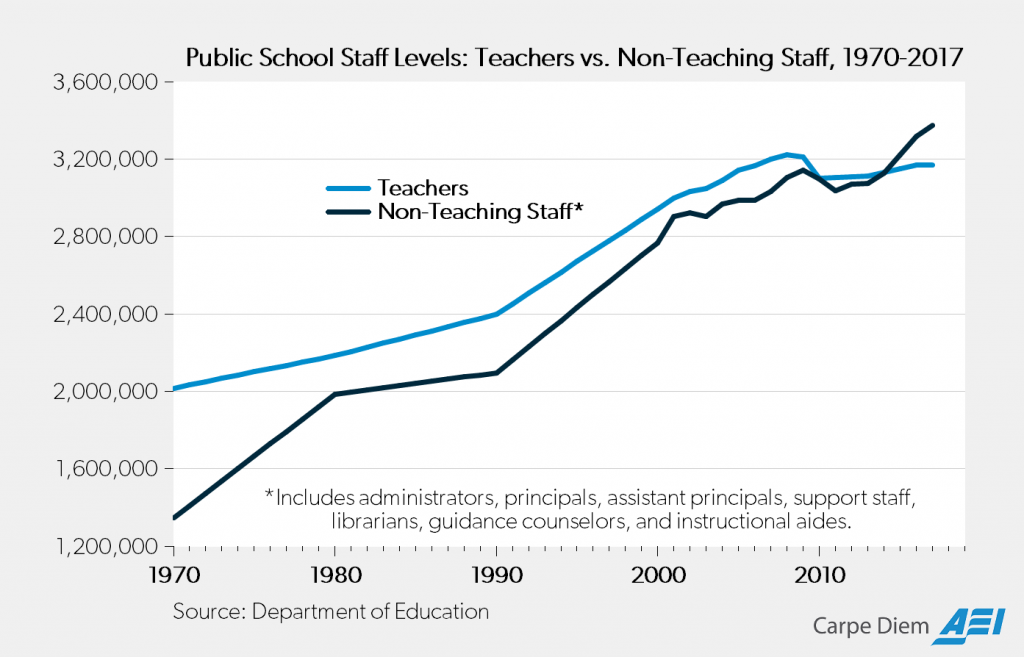
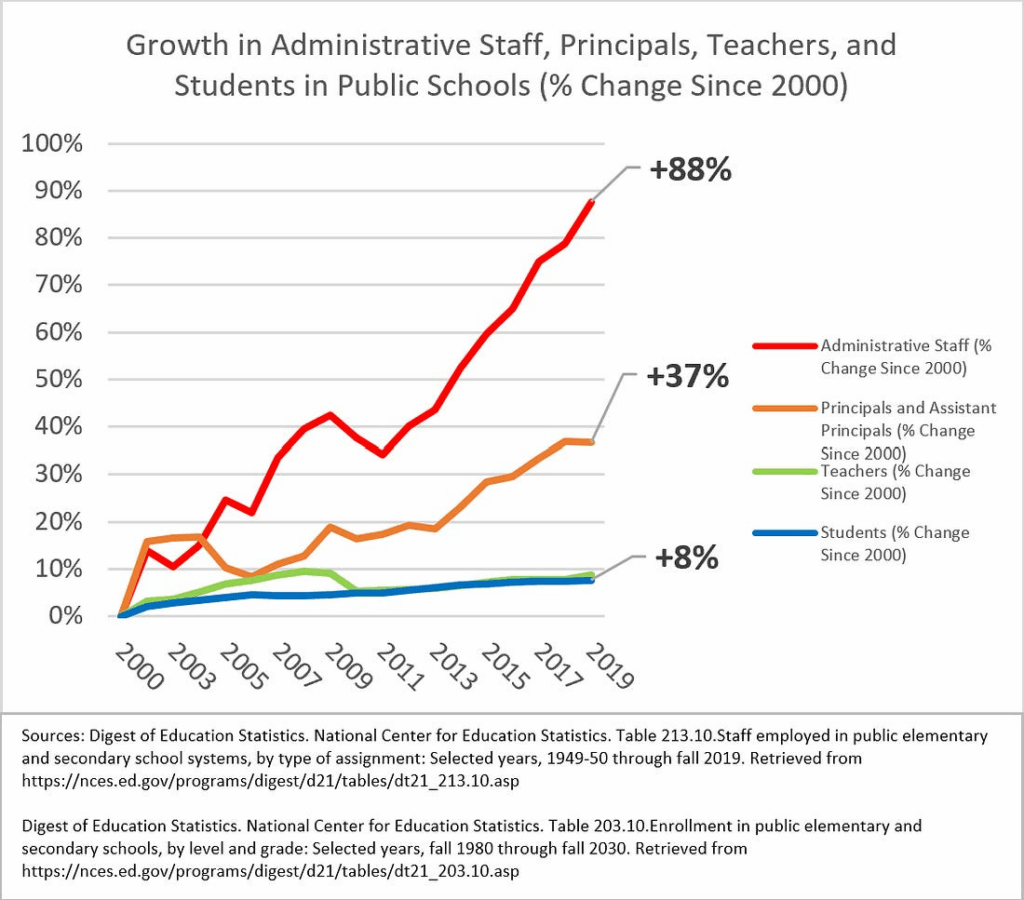
At the same time, the fiscal pressures many school districts are now feeling were seeded long before COVID-19. Over several decades, public school staffing levels grew steadily even as student enrollment did not. This growth wasn’t necessarily focused on hiring more classroom teachers. Instead, many districts expanded their ranks of administrative and support staff, creating a long-term structural cost burden that is difficult to unwind in the face of shrinking enrollment and expiring pandemic-era federal relief funds.
These charts from the American Enterprise Institute tell a clear story:
Finally, we can’t ignore one of the most significant forces reshaping K–12 education: the rapid expansion of and demand for public and private school choice. Over the past decade, a growing number of states have passed legislation that empowers families to choose from a broader range of educational options, including charter schools, private school scholarships, open enrollment, education savings accounts, microschools, homeschooling and hybrid models.
These programs are designed to be flexible and responsive to individual student needs, and they’ve resonated with families who are seeking alternatives to one-size-fits-all solutions. The result has been an unprecedented shift in how and where students are educated, with many choosing to leave the traditional public schools to which they historically have been assigned.
These underlying trends all have one thing in common: They are not going to change course quickly, if ever, making declining enrollment an issue that states must begin tackling now or risk decades of future financial hardship. To avoid being caught off-guard, policymakers must begin taking action to address the high-level impacts of this enrollment decline and adapt our education system for a new reality.
State funding is generally based on student enrollment, which means significant enrollment drops can create financial challenges for school districts that have fewer students. To help districts and avoid difficult conversations, states may feel tempted to keep funding districts as if they had the same amount of or more students. However, funding so-called “ghost” students is very expensive for states.
At a minimum, state policymakers should carefully consider whether these resources can produce greater benefit to students if used in other ways. Instead, as states prepare for and face the enrollment decline, here are 14 ways state policymakers can help school districts reduce expenditures without harming students while seizing opportunities created by freed up funding, facilities and staffing.
The data is clear, the trend lines are steady and the consequences of inaction are growing. Declining enrollment isn’t a temporary dip. It’s a structural shift. Yet far too many school systems are clinging to outdated assumptions and unsustainable models.
This moment demands forward-thinking leadership, not short-term patches. States and districts need to start making smart, strategic decisions now—about facilities, staffing, and funding formulas—so they aren’t forced into crisis-driven cuts later. That means embracing hard truths, engaging communities honestly and designing policies that reflect the future, not the past.
ExcelinEd recommends state leaders help districts prepare for what’s ahead by increasing flexibility and collaboration, strengthening student-centered funding and developing innovative solutions to everyday challenges like transportation and buildings. Just as importantly, states must give districts the time and tools to plan, not just react.
If you’re a policymaker or district leader grappling with these challenges, ExcelinEd is here to help. Reach out to our team to learn more about how we can support your efforts to navigate enrollment decline with clarity and purpose.
