Sam Duell is the Policy Director for Charter Schools at ExcelinEd.

This week U.S. News & World Report published their 2018 rankings for the top public high schools in the U.S. There’s plenty of good news for states like Arizona who boasts six of the top 10 public high schools, and for Florida who earned 13 spots in the top 100.
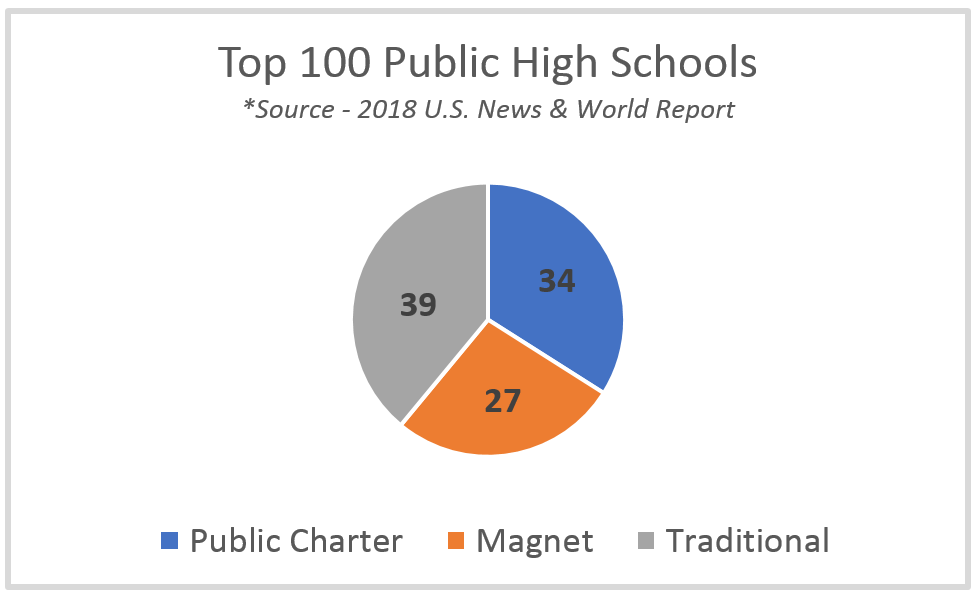
And there continues to be good news for public charter schools. Thirty-four of the top 100 public high schools are public charter schools and seven of those thirty-four belong to one organization, BASIS.
This is especially significant when you consider that according to the National Center for Education Statistics (NCES) only 7.5 percent of public schools in the U.S. are public charter schools; that’s 7.5 percent of schools representing 34 percent of the best schools.
One might reasonably wonder, how does poverty play a role in the U.S. News & World Report rankings? I had the same question, and this year we have some data that adds context to challenges facing low-income families. To answer this question, we will need to define some terms first.
How many top public high schools receive Title I funding? Thirty-eight of the top 100 public high schools receive Title I funding.

What does that mean? According to NCES, about 48 percent of families in the U.S. qualify for FRPL. Looking at the data, we see a gap in the number of families who are eligible for FRPL (48 percent) and the number of top public high schools who serve concentrations of low-income families (38 percent). One might call this an opportunity gap. This means if your family qualifies for FRPL, then you are much less likely to have access to one of the best high schools in the country.
How do the top public charter schools compare with the top magnet and traditional public schools when it comes to serving low-income communities? Forty-seven percent of the top public high schools receive Title I funds compared with 33 percent of magnet schools and 33 percent of traditional public high schools. Since BASIS schools are somewhat of an outlier in terms of performance and in terms of not receiving Title I funds, we might exclude BASIS from the data and then one might say 59 percent of the top public charter schools serve large percentages of low-income families.

What does this mean? This data shows that while public charters are over-represented in the rankings when compared proportionally to their magnet and traditional school counterparts, the best public charters are also serving many more low-income families than the magnet or traditional schools.
What challenges and opportunities does this reveal? This report clearly indicates that too many low-income families lack access to the best public high schools, and, while public charter schools are performing better than expected, there is much more work to do. The challenge is to expand opportunity to every family regardless of their income. Thankfully, Fordham provided a map for this work a few weeks ago. And the opportunities are more exciting than they were last year. As my colleague Adam Peshek wrote this week, “a new federal tax incentive could hold the key to spurring billions of dollars in investment in low-income areas with limited access to quality public charter school options.”
This year’s rankings of public high schools send a clear message: public charter schools are serving low-income families well, but not enough low-income families have access to high-quality public high schools. It’s time to expand educational opportunity for the families who need it the most.
