Learn the steps lawmakers should take to improve early literacy policy and implementation.
Quality
Strong early literacy skills are crucial for children’s success in school and life, and for more than a decade, states have been adopting policies to ensure educators, parents and young readers have the resources they need to improve literacy across the United States, where right now only one-third of fourth graders in the United States are reading proficiently.
Last year, 10 states took action to pass legislation that ensures evidence-based early literacy policy is prioritized in their K-12 systems. Many more are considering legislation to improve their literacy policies this year.
Despite this rapid growth in early literacy policy adoption, not all states have seen consistent academic growth as a result, and some have seen no growth at all.
ExcelinEd recently launched Early Literacy Matters 2.0, an updated version of an online tool that can provide state policymakers with valuable insights into their state’s current standing on early literacy policy adoption and implementation.
Numerous tools provide basic information on which early literacy policies have been adopted. Early Literacy Matters 2.0 is the first tool of its kind to take such a deep dive into how state-level policy is being implemented.
Early Literacy Matters 2.0 includes 18 Early Literacy Fundamental Principles broken down into four key areas:
Supports For Teachers & Policy: Educators know that learning to read is a continuum of ever-increasing knowledge and skills. While teachers support that progress, not all teachers are well prepared to teach reading unless they have training in evidence-based instruction grounded in the science of reading.
Assessment & Parent Notification: Early literacy screenings often provide a “first alert” that a student may need extra support to become a proficient reader. Screenings also help teachers tailor instruction and develop intervention plans to meet individual student needs.
Instruction & Intervention: Educators must be equipped with the tools and resources needed to prevent reading difficulties through evidence-based literacy instruction and high-quality instructional materials and provide interventions for students who are struggling to read.
Retention & Intervention: Retention is a last resort that provides struggling readers the additional time and intensive interventions they need to catch up with their peers. These students have been identified as severely below grade level and would benefit from an additional year with a highly effective teacher.
Using the 18 principles, ExcelinEd conducted a 50-state scan that looked not just at which policies states have enacted, but also how states are implementing them on the ground. This updated tool also includes best practices.
This guide will walk you through the tool and empower you to make data-driven decisions to improve your state’s early literacy outcomes. Please note that this tool will be updated annually, so legislative and implementation changes currently underway will be reflected in the 2025 update.
Step 1: Access the Literacy Map Tool and Find Your State
This will take you to a 50-state map where you can select your state.
Step 2: Analyze How Your State Is Doing on Early Literacy Implementation
Each state report is broken down by the four key policy areas and includes a rating for implementation of each of the 18 policy components as well as an overall rating. Compare your state’s adoption and level of implementation to other states by filtering the map by the four key areas and fundamental principle.
Carefully review each principle’s rating and supporting information. This will help you identify areas where your state can strengthen its early literacy policies and implementation.
If you want to dive deep into any or all of the policy areas, each state page includes a full report that breaks down the implementation of every fundamental principle within the state.
Step 3: Identify Your State’s Areas for Early Literacy Policy Improvement
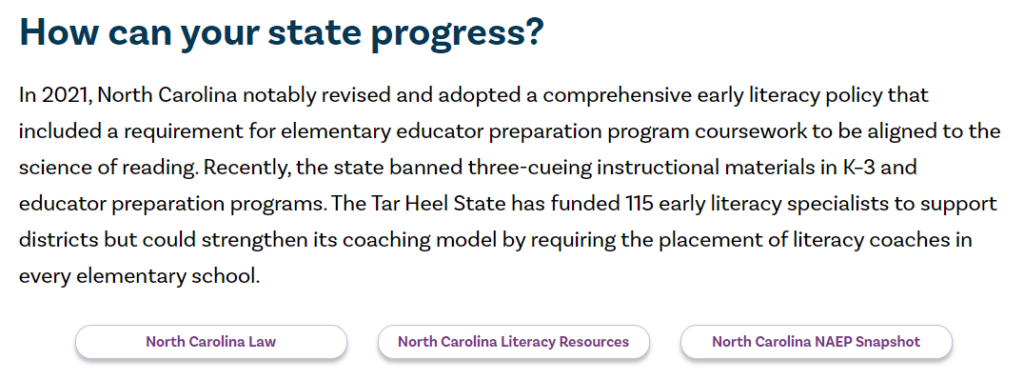
Your state’s comprehensive report includes details on how to improve a particular policy area and a section on your state page with information about how your state can improve overall:
There’s also a section on the Early Literacy Matters site (the Comprehensive Policy tab) that breaks down the common policy challenges states face along with best practices to avoid those pitfalls:
Finally, if you want to see results for every state side-by-side, there’s a downloadable PDF that includes NAEP scores and how every state stacks up on fundamental principles adoption, including the years legislation was passed and code citations if you want to check out how the law was written.
Step 4: Take Action – Use Recommendations to Continue Improving Early Literacy Policy and Implementation
The Early Literacy Matters website is designed to help policymakers understand where their state stands when it comes to early literacy policy and implementation—and what they can do to improve in the future.
With 18 fundamental policy principles to consider, a policy and mindset shift of this magnitude can feel like a lot.
We also know this work doesn’t happen in a vacuum or on a website; we are here to help you design solutions that make sense for your state.
By utilizing this resource and following these steps, policymakers will gain valuable insights and be well positioned to advocate for changes that will strengthen state-level early literacy policies and empower all students to become proficient readers.
Tom Greene is the Vice President of Advocacy for ExcelinEd. In this role, he manages the organization’s advocacy and government affairs team and works with leaders and policymakers from across the states to promote student-centered solutions focused on educational quality, innovation and opportunity.