Christy Hovanetz, Ph.D., is a Senior Policy Fellow for ExcelinEd focusing on school accountability and math policies.


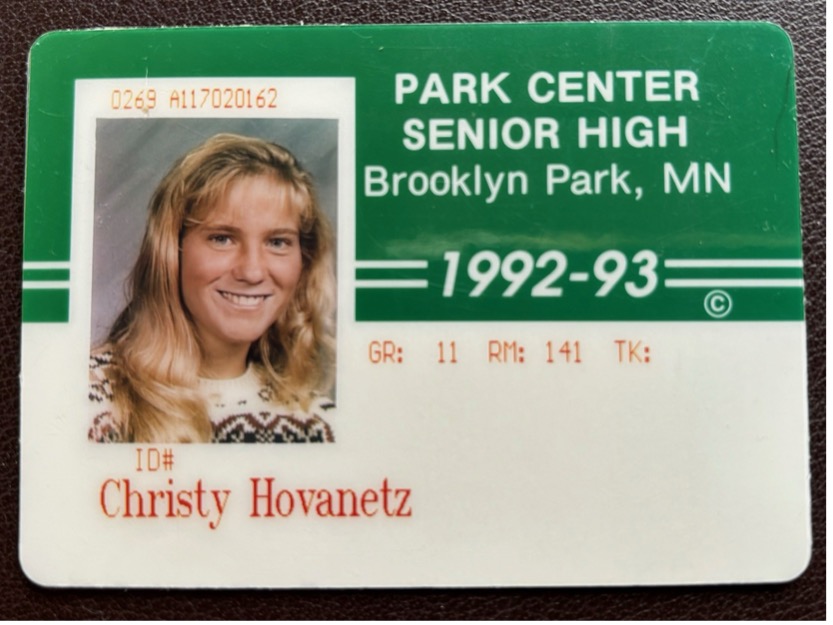
I attended my high school reunion this past weekend. For old time’s sake, we threw a house party that featured a classmate’s band in the garage with red Solo cups for $10 at the door.
The early 1990s were known for their relative peace and prosperity, which allowed us high school kids to focus on the best things in life: the Chicago Bulls dynasty; great TV shows like “Saved by the Bell” and “Fresh Prince of Bel-Air”; Jim Carrey and Pauly Shore movies; the rise of the internet and a new book retailer called Amazon; and, of course, our outstanding sense of fashion.
Combing through my high school yearbooks reminded me that ‘90s fashion was hard to pin down. The style was decidedly low-maintenance, with baggy, high-waisted jeans, oversized sweatshirts and clunky Steve Madden shoes. Hair was scraped into scrunchies or left flouncy and un-styled. By the time I graduated, grunge was raging, and “The Rachel” hairstyle showed up on the scene.
Fashion visibly shifts over time, and observers can establish trends and themes through the decades.
This past summer, economists Hans-Joachim Voth and David Yanagizawa-Drott published a study called Images that takes analyzing American high school fashion trends to a mathematical level.
Using AI, the duo analyzed more than 14 million U.S. high school senior photos, collecting data from 1930 to 2010 about what students were wearing through the years.
The AI output was fed into a mathematical model to analyze how fashion has changed over time, measured by:
This first-ever. comprehensive, data-driven analysis of the evolution of style allowed the researchers to document many different trends, some of which were already known and others of which went previously undetected.
Designing and creating fashionable garments also requires math.
Fashion designers use linear and angular proportions to calculate the length of a sleeve or pant leg; to know the amount of material needed; and to account for volume measurements. Mathematicians Euler and Monge’s work in differential geometry, drawing useful mappings of curved surfaces, are mathematical principles used to design woven fabrics that best wrap around bodies. Perpendicularity and parallelism are key concepts in patternmaking. Tiling and patterns for fabrics have been inspired by tessellations and fractals.
Implementing good policy is always in style. Fashion a strategy for improving student outcomes based on ExcelinEd’s math policy fundamental principles and comprehensive K-8 math model policy.
There are 177,147 ways to tie a necktie, though some are admittedly more practical than others. While the fashion importance of neckties has diminished, a group of Swedish mathematicians led by M. Vejdemo-Johansson was inspired after seeing a new tie knot in the movie The Matrix to update the conservative 85 Ways to Tie a Tie Knot: The Science and Aesthetics of Tie Knots, written by physicists Thomas Fink and Yong Mao. While Fink and Mao’s writing underestimates the number of possible knots, the book explains the math behind how a knot is tied and the fundamental role that math plays in the way we dress with style.
