Christy Hovanetz, Ph.D., is a Senior Policy Fellow for ExcelinEd focusing on school accountability and math policies.


America’s K-12 public school students spend more than 60 billion hours in the classroom every year, supported by $950 billion in public investment. Education is one of the largest expenditures in state budgets, and its impact is felt beyond the walls of any classroom. The education that takes place in a school building not only shapes workforce readiness, but it also influences economic growth, national security and the strength of our civic institutions.
Student achievement, as measured by the National Assessment of Educational Progress (NAEP), has declined across the country over the last decade, compounded by the COVID pandemic. Reversing this devastating trend requires that all schools be held accountable for all students meeting clear, meaningful and rigorous expectations. It also requires systems to transparently report data that can be used to take action.
School accountability systems are central to improving student achievement. With strong design, they can make student performance transparent, report data for decision making, show what is working and what needs to change, aid resource allocation and ultimately ensure schools are delivering results.
To support an informed and productive conversation on school accountability ExcelinEd developed a video series with Senior Policy Fellow Christy Hovanetz, Ph.D. The series is designed to provide a clear explanation of how modern accountability systems work, address common misconceptions and equip policymakers and advocates with the knowledge needed to strengthen systems and improve student outcomes.
Below is a closer look at what the series covers, why it was created and why it matters. If you’re ready to skip ahead and dive into the playlist, you can start watching here.
This video series is a comprehensive, policy-focused review of school accountability systems, including everything from how they work to why they matter—and how these systems can be strengthened.
Through various segments, the series walks through elements on the history and development of accountability systems, including:
This video series is a practical guide to identify the fundamental principles to design, implement, and improve school accountability systems. The best student outcomes occur when clear measurements and rigorous expectations are combined with transparent reporting.
This video series exists to explain how school accountability works and why many systems are not fulfilling their goal of improving student outcomes. It examines the history of policy and current realities of assessment and accountability practices to provide policymakers with a clear understanding of how strong school accountability systems can incite action to improve student academic achievement in their states.
Under NCLB, states were required to set clear standards, test annually, report results by student group and intervene when it came to perpetually underperforming schools. While the law’s 100% proficiency goal was not achieved, the NCLB era produced the largest improvements in student achievement and the most significant narrowing of achievement gaps ever recorded on NAEP.
Federal policy shifted under the Every Student Succeeds Act (ESSA), which granted states flexibility in structuring their accountability systems. Many states opted to lower expectations and water down accountability metrics. Many states also shifted emphasis away from purely academic outcomes. The result, was academic stagnation and a gradual decline which became worse during the COVID 19 pandemic, and student achievement has yet to recover.
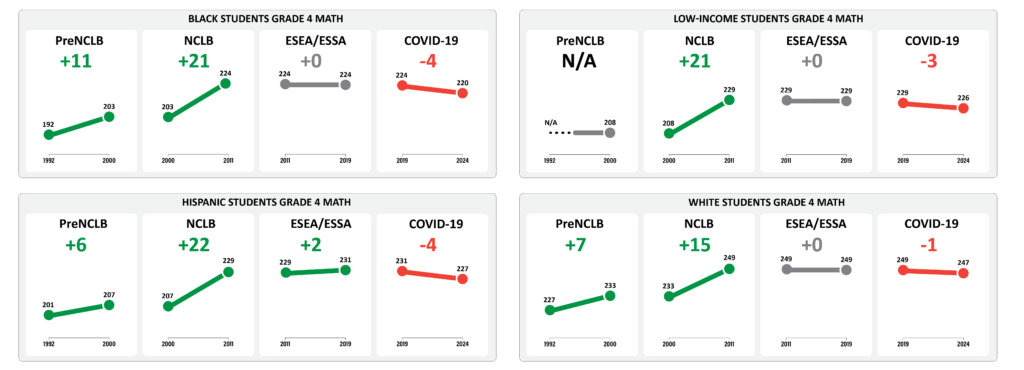
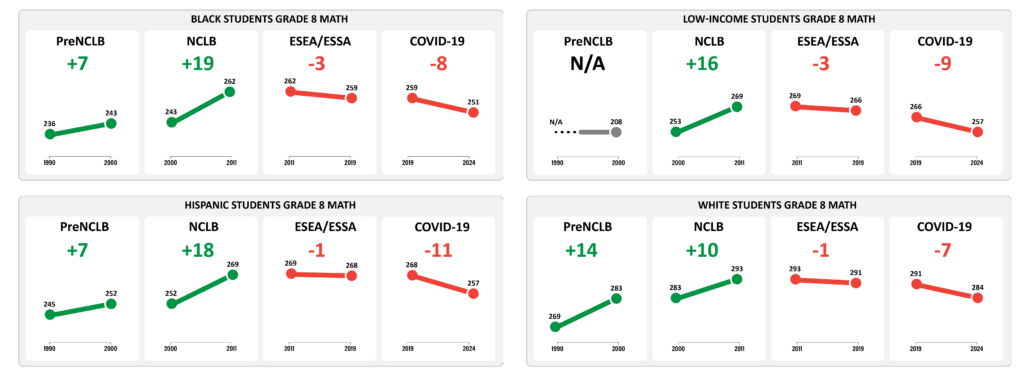
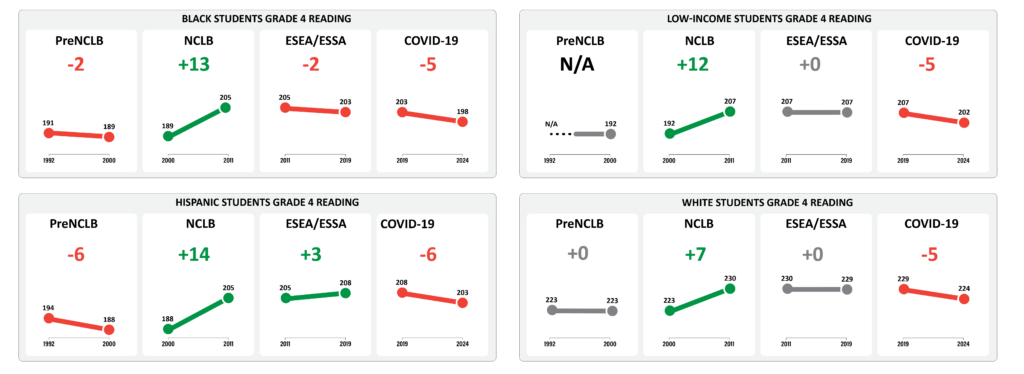
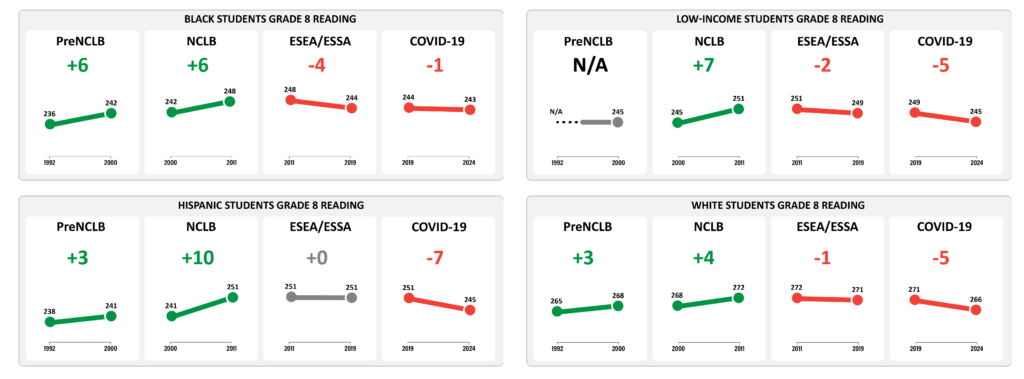
Assessments have evolved over the last decade. The notion that these assessments consist of students filling in “bubble” sheets with a no.2 pencil is an outdated perception, as is the idea that teachers “teach to the test.”
Today’s state tests are digital and adaptive. Students may complete multi-step math problems, virtual science simulations or performance-based tasks that require real demonstration of understanding, not just selecting a multiple-choice option. Many states use technologies for automated scoring which speeds up returning results to families and providing accessibility features allowing more students to fully engage with the tests.
Accountability systems shape the incentives and priorities across K-12 education nationwide, and education expenditures represent one of the largest line items in state budgets. The outcomes of students’ education influence their lifetime earnings, workforce readiness and civic participation. To that end, it is important for accountability systems to:
They identify where students succeed, highlight what policies are working and influence future strategic investment. However, when these systems are ill-designed, or designed in a way intended to obfuscate actual student performance, outcomes won’t improve because there is no incentive for policymakers or educators to act and change practices.
Recent national polling shows strong support for annual testing and monitoring student progress.
Voters consistently prioritize foundational reading, writing and math skills. When asked to select the two most important pieces of information to understand how well a school is performing, voters overwhelmingly selected academic outcomes measuring grade level performance and growth over time.
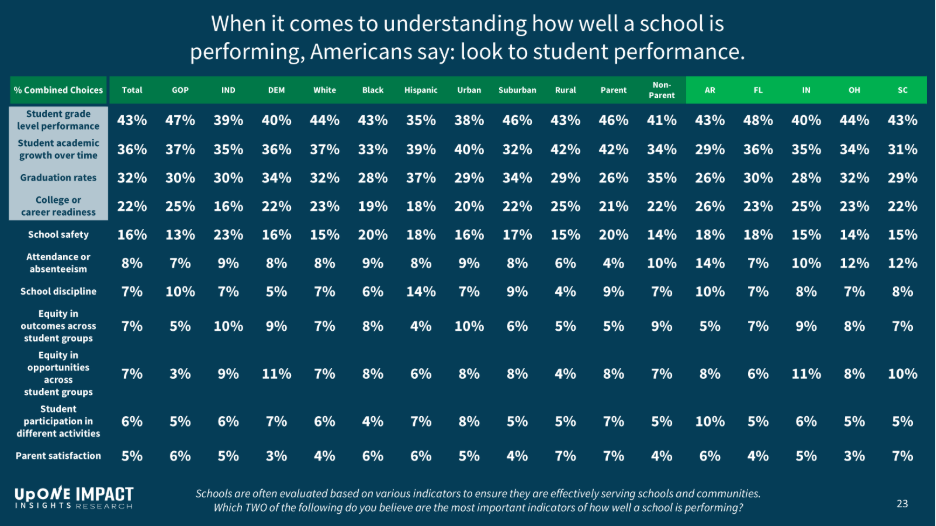
The public discourse also demonstrates an opportunity for policymakers.
The video series moves from foundational concepts to methods for practical application in your state. Viewers will be able to develop a clear understanding of how strong accountability systems function and methods for improvement.
The first videos begin with policy history and an examination of what has worked under past approaches and how shifts in policy have impacted student outcomes today.
From there, the series looks at modern assessments and discusses how computer-adaptive tests operate, what they measure, and how they provide more accurate and actionable insights than past iterations.
You will also be able to explore how assessment results should be interpreted and used, to include how reporting timeliness can be impactful, as well as the methods stakeholders can use to act based on the data.
Several videos focus on strong school accountability design, to include:
Common misconceptions are addressed while examining evidence from real-world case studies. You hear about successes in states like Florida and Mississippi, where strong accountability systems paired with instructional reform led to long-term improvement in academic achievement.
Finally, the series explores how data from assessments including NAEP results can inform decision making.
Ep. 1: Does School Accountability Work?
Ep. 2: Why Accountability is Important
Ep. 3: What Do Modern Tests Look Like?
Ep. 4: Innovations in Modern Testing
Ep. 5: Why Do State Test Results Take So Long?
Ep. 6: How Should States Use State Test Results?
Ep. 7: Explaining “No Child Left Behind”
Ep. 8: Explaining the “Every Student Succeeds Act”
Ep. 9: Assessment OF Learning vs. Assessments FOR Learning
Ep. 10: What are Cut Scores?
Ep. 11: What Goes in a School Accountability System?
Ep. 12: What is an “Honesty Gap?”
Ep. 13: Test-Based School Accountability and Why It Works
Ep. 14: The Impact of a Successful Test-Based School Accountability System
Ep. 15: What Is a Criterion-Referenced Test and a Norm-Referenced Test?
Ep. 16: Why Do We Need School Accountability Summative Ratings?
Ep. 17: How Should We Measure Student Academic Achievement?
Ep. 18: How Should We Measure Student Growth?
Ep. 19: What is More Important: Achievement or Growth?
Ep. 20: Focusing on the Lowest Performing Students Leads to Success
Ep. 21: What is an Example of a School Accountability Indicator?
Ep. 22: Key Questions to Ask When Considering the Inclusion of an indicator in a School Accountability System
Ep. 23: Do People Still Care About Assessments and Accountability?
Ep. 24: What is NAEP and Why Does it Matter?
Ep. 25: How Should I use Accountability Results and When Will I Start to See Change?
Ep. 26: How Does School Improvement Relate to School Accountability?
Only a strong commitment to measuring proficiency and growth with intent toward full transparency, paired with improvement policy and instructional strategies, will lead to exceptional improvements in student achievement. Shifting focus away from grade-level expectations will not prepare students for college or the workforce, and obscuring student performance will not close achievement gaps.
The full video series is embedded below. We invite you to watch and share with colleagues. If you would like more information about how your state can design accountability systems to improve the future of its students, please contact us.
