Ben DeGrow is a Senior Policy Director of Education Choice for ExcelinEd.


Private school choice has transformed over the past 30 years from small programs with limited eligibility into a national movement that provides millions of families with the opportunity to customize their children’s education.
At its core, private school choice allows public education funds to follow students to the learning environments that best meet their unique needs, rather than being assigned to a specific assigned school building.
Private school choice programs enable parents to use state-sanctioned funds to pay for private school tuition and other educational expenses. This movement began more than three decades ago in Wisconsin and has since expanded to more than 30 states and Washington, D.C. Today, more than 1.5 million students participate in these programs nationwide.
There are several primary types of private school choice programs:
Families choose these programs for many reasons, including a desire for better academic fits, safer school environments, specialized services for students with disabilities or to align their child’s education with their personal values.
In this post, we’re going to look at what the research on private school choice says—both broadly and diving deep into each area that’s been studied.
Private school choice is one of the most-studied areas of K-12 education policy, and extensive research conducted over the last 30 years suggests that when choice is available, everyone benefits—not just the students who switch schools. Among the issues researchers have looked at:
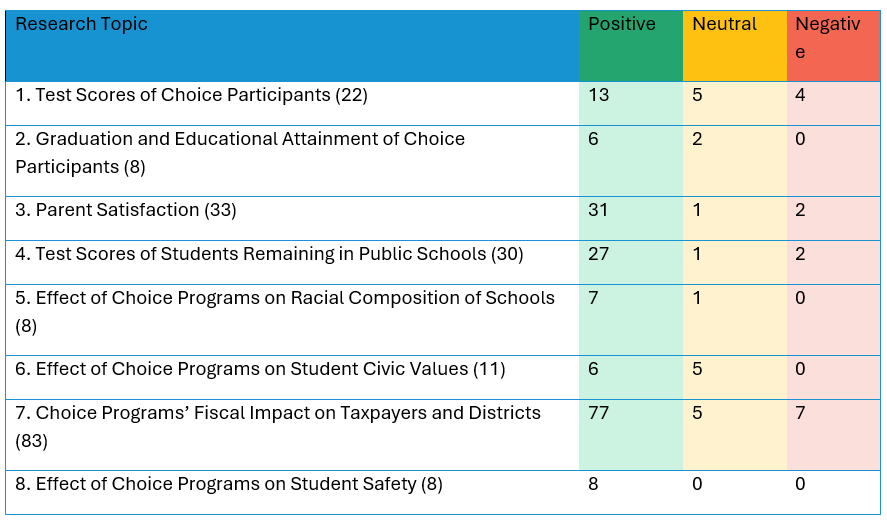
A thorough literature review by the national organization EdChoice examined 203 rigorous studies of outcomes and impacts. Those studies identified a total of 175 positive effects, 15 negative effects, and only 20 (about 10% of the total) cases of no visible impact one way or the other.
The studies are sorted into eight main research topics of interest, and break down as follows:
When reviewing research on private education choice, there are three types of studies available:
Of the 22 empirical studies on the academic outcomes of participating students, 13 show positive results for participants, five have neutral findings and four have negative findings. For example, participants in the Milwaukee Parental Choice Program scored 10.7 percentage points higher in math and 5.8 percentage points higher in reading than public school peers.
Of the eight empirical studies on attainment outcomes of participating students, six show positive results for participants, while two reveal no impact. No negative outcomes have been found. According to a 2025 study, Ohio’s predominantly lower-income EdChoice scholarship recipients were 32 percent more likely to enroll in college within two years after graduation and 60 percent more likely to complete a bachelor’s degree than the control group. Effects were stronger for students who stayed in the program longer.
Thirty-one of 33 empirical studies find parents are more likely to be satisfied with their child’s education because of participating in a choice program. For instance, a survey of 3,000 Indiana parents of voucher and scholarship students were 5-7 percentage points more likely to be satisfied (and 10-20 percentage points more likely to be completely satisfied) with their child’s school than their counterparts with children in district public schools.
Twenty-seven of 30 empirical studies show improved academic outcomes of students who remain in public schools after education choice programs are implemented. A 15-year study of Florida’s expanding private choice program found that students in public schools facing the most competitive pressure made significantly greater gains in reading and math achievement and were substantially less likely to miss days of school, including for disciplinary reasons.
Seven out of eight empirical studies show that choice programs move students from more segregated schools into less segregated schools, with the other study showing no impact. As a researcher noted after studying a Louisiana voucher program: “The bottom line take-away from our analysis is that 82 percent of student transfers made possible by the Louisiana Scholarship Program reduced racial stratification in the voucher students’ former public schools, a clear win for desegregation efforts in the state of Louisiana.”
Of 11 studies, six show positive effects on participants’ civic values, while the rest showed no effect. A 2008 report reviewed 21 studies that looked at the effect of education choice on seven civic values: political tolerance, voluntarism, political knowledge, political participation, social capital, civic skills and patriotism. In nearly all cases, there was an advantage for schools of choice compared to public schools in promoting these values. The researcher writes, “The most intriguing explanation for the apparent education choice advantage in promoting civic values is a generally higher level of order and discipline in schools of choice.”
Among 83 empirical studies on education choice’s financial impact on taxpayers and school districts, there are 77 findings that choice programs save money, five that show choice programs are revenue neutral, and seven that show added costs to taxpayers. Dollars awarded through a choice program represent expenditures from the state treasury. But those costs are more than offset by allocating at a lower rate than the public school per-pupil rate.
A 2021 EdChoice report surveyed 40 choice programs around the nation and found cumulative savings between $12.4 and $28.3 billion, or between $1.80 and $2.85 recouped for each dollar spent. In a typical program, if half the funded choice students switch from a public school, the result is a net positive fiscal impact.
All eight empirical studies analyzing the effects of education choice on school climate and safety identified a positive impact. Parents commonly report student safety as a primary factor in selecting learning environments for their children. This encompasses concerns around bullying incidents, discipline policies, and general school climate. A 2019 evaluation of the D.C. Opportunity Scholarship Program found that, after three years, participating students were 16.8 percentage points more likely to perceive their school as “very safe” than their peers without scholarships.
Though neutral or negative findings in private school choice research are rare, we wanted to address a few of the studies that often are elevated by critics as reasons to limit education choice.
The Institute of Education Science (IES) released a report in 2019 analyzing third-year outcomes for students participating in the DC OSP. The report found neutral results in math and reading achievement (not statistically significant impacts for students after three years in the program). However, consider the following:
A gold standard 2018 IES report showed academic gains for DC OSP students, particularly in the long-term. It is common for students to enjoy greater achievement gains when they participate in a choice program for longer durations. The same report found that DC OSP “had a statistically significant positive impact on both parents’ and students’ general perceptions of school safety.”
DC OSP students receive significantly less funding than their counterparts in district and charter schools. Voucher students receive no more than $10,200 in grades K-8 and $15,300 in grades 9-12, compared to nearly $25,000 in D.C. charter schools and over $36,000 in district public schools.
A 2017 study by R. Joseph Waddington and Mark Berends on academic outcomes in Indiana’s Choice Scholarship Program (CSP) suggests a statistically significant decline in math scores, primarily during a student’s first and second year in their new private school. However, performance improved for students that remained in the CSP. After four years, CSP students surpassed their public school peers in English and regained level-footing with their peers in math.
A 2016 study of Ohio’s EdChoice Scholarship Program (not affiliated with the national organization), showed that “students, on average, who move to private schools under the EdChoice program tend to perform considerably worse than observationally similar students who remained in public schools.”
The study’s negative findings are tempered by a research design that falls short of the gold standard. EdChoice students during the years studied were only eligible if their public school academically fell below a certain level based on state testing. The study looked at students near this cutoff—those who earned participation because their school barely made eligibility and similar students in schools who just missed eligibility—and compared their performance over time. Because of this methodology, the researchers could not study students who would have been most likely to benefit: students from the lowest-performing public schools.
Notably, the authors also observed that “the EdChoice program improved the performance of students eligible to participate—most of whom remained in the public schools.” In other words, students who were eligible but did not use scholarships saw achievement gains.
The predominant and fastest-growing form of private education choice is Education Scholarship Accounts, or ESAs. These state-supervised accounts enable parents to direct state funds to meet their children’s needs through a variety of education goods and services, not just private school tuition.
Given that most families use ESAs like a voucher, to cover tuition costs, the existing body of research on school choice similarly applies. Otherwise, among the 203 studies EdChoice has identified, 11 specifically analyze the impacts of ESA programs—seven for fiscal effects and four for parent satisfaction. Most of these studies yield positive findings, though not to the degree of the overall sample.
Publicly available outcome data on ESA programs is limited, but several states require reporting:
Research on the impacts of choice programs with universal eligibility is even scarcer. Arizona first put universal choice into action in 2022. In the past four years, a dozen other states have brought universal programs online, with several more slated to join them in the months and years ahead. Due to their relative newness, and in some cases limited relevant data, little is known about whether and how such an expansive student eligibility design might affect academic findings.
In September 2025, the National Center for Research on Education Access and Choice released an analysis focused on the rapidly rising number of states that have dramatically expanded choice program eligibility. The primary findings identified from this nascent national trend were modest increases to private school tuition rates (5-10%) and enrollment (3-4%), with disproportionate growth in smaller, more affordable Protestant religious schools.
Private education choice has expanded on a firm foundation of favorable research, covering a broad range of metrics associated with student well-being and societal health. But current and future academic investigations as the sector continues to experience dynamic changes should only further refine and reshape our understanding of these policies’ short-term and long-term impacts.
As private school choice continues to expand across the United States, it provides an educational landscape where every child has the opportunity to succeed.
Private school choice is and will continue to be one of the most rigorously studied areas of American education policy. Decades of evidence overwhelmingly demonstrate that these programs deliver positive outcomes for students, families and the broader public school system alike.
As this movement continues to reach more states, we look forward to the insights that ongoing research will provide. We remain committed to working alongside state leaders to ensure these programs are designed and implemented to provide the maximum possible benefit to every family they serve.
