
ExcelinEd is a national nonprofit transforming K-12 education to ensure success for every child with student-centered, state-based policy solutions. We collaborate with partners and education leaders to research, develop and implement policies that prioritize early literacy, empower families with education choice, expand innovation, strengthen school performance and prepare students to transition from education to the workforce.
These brief summaries reflect some of our policy focus areas in 2024. If you don’t see an issue you’re looking for, please contact us to request more information.
The purpose of a school accountability system is to spur school improvement and increase student performance by providing transparent, objective information to parents, educators, and the public about school effectiveness. A, B, C, D and F school grading recognizes success and exposes failure in a way that everyone can understand.
Students may face a digital divide if they lack an educational device such as a tablet or laptop at home, because smartphones are ill-suited to in-depth academic assignments. They may also experience lack of home broadband connectivity if their family cannot afford a broadband plan or if infrastructure does not reach their residence.

Six recommendations outlining strategies both state education agencies and policymakers can
leverage to strengthen cell phone and social media guidelines in states, as well as examples of pioneers who have already done so.
A comprehensive early literacy policy ensures students receive high-quality instruction rooted in the science of reading and identifies and supports students with reading difficulties as early as possible, catching them before they fall behind.
HQIM are aligned to the science of reading and evidence-based approaches to teaching reading. They are aligned to state standards and designed to help all students.
Research shows that students who can’t read proficiently by 3rd grade are 4 times more likely not to graduate from high school. Retaining students for a year is an important last resort for students who need additional time and support to catch up with their peers. Every state should also have multiple pathways for promotion and a good cause exemption policy which allows students with special circumstances to move on to 4th grade with an individual reading plan and appropriate supports.
A universal reading screener is a brief, easy to administer assessment that determines if students are at grade level in reading or if they are at risk of difficulties.

A literacy coach is an instructional leader with specialized knowledge in the science of reading, evidence-based practices, English Language Arts state standards, curriculum and other instructional materials, as well as the knowledge of how to work with educators as adult learners.
The United States has relinquished its mathematical prowess enjoyed in the 20th century with trending declines in performance on international and national measures and must make a concerted effort to regain this standing in the 21st century.

To become proficient in math, students need to develop mathematical proficiency, which is a combination of: real-world problem-solving skills (connecting math to student’s lives), procedural fluency (the ability to perform math procedures with
speed, accuracy, efficiency and flexibility), conceptual understanding (knowing how and why math “works”) and productive dispositions (seeing math as sensible, useful and worthwhile).

A universal screener is an assessment that evaluates student proficiency with grade appropriate math concepts and flags concepts that students have not mastered. Universal Screeners act as a “first alert.” Teachers use thevstudent level data that screeners generate to tailor instruction to individual learning needs. Teachers shouldvthen rely on ongoing formal and informal progress monitoring tools, such as observations, interviews, and
benchmark assessments to determine student progress.

High Quality Instructional Materials (HQIM) are curricula, textbooks, supplemental materials, and teacher guides that are rooted in evidence-based approaches to teaching math that improve student outcomes and help all students achieve grade level math learning goals.

Consistent, daily mathematics instruction is vital for providing all students with a strong math foundation. Despite this, only one state, Alabama, ensures that schools prioritize a daily dedicated block of uninterrupted instructional time for math teaching and learning in the daily schedule. When states prioritize a set amount of daily instructional time, it ensures that all K-8 students have access to grade-level math expectations and provides time for personalized learning and/or remediation.
Advanced mathematics opportunities allow students to move through math course sequences at a faster pace. Automatic enrollment ensures that students have access to the mathematics courses that are appropriately challenging and enriching and requires no added registration paperwork or meetings. For too long, many students who should have been in advanced math opportunities were not given access to those courses.
At ExcelinEd, we call the data used for higher education accountability a Return on Investment Analysis. A comprehensive ROI analysis evaluates whether postsecondary programs lead to positive outcomes such as strong wages, continued education or qualified military enlistment. It also tells stakeholders whether those outcomes align with high-demand, high-skill, high-wage occupations in a state’s economy.
Career and technical education (CTE) offers students the opportunity to develop a strong academic foundation and valuable, real-world technical skills while they are still in high school.
An ROI analysis by the state helps determine whether investments, such as time or money, are providing desired results.
An SLDS is a database that provides a single point of access for various stakeholders, including policymakers, the media and the public to view a wide range of education, employment and other data from various sources. Ideally, an SLDS presents data in a simple, easy-to-understand manner while maintaining individual privacy.
College acceleration opportunities offer high school students the chance to prepare for college-level expectations while earning valuable college credit.

Data science equips students with the introductory skills and problem-solving that are necessary to collect, analyze, interpret, model, and visualize data. In K-12 education, data science focuses on the systematic processes, analytical techniques, and use of appropriate technologies to gain knowledge from data. Data science draws upon tools and methods in areas such as mathematics, statistics, and computer science.
An ESA is a state-supervised spending account that families can use to purchase various approved educational services they choose for an eligible child, not just for tuition at a private school.
Every student has their own unique learning needs. A student’s local district may not have all of the services students are looking for to meet these needs. Rural schools don’t always have the scale to offer a wide breadth of learning options. Additional opportunities beyond the district can help rural families meet the needs of their children and strengthen the local community.
Open enrollment offers families the flexibility to choose schools beyond their local district boundaries. These policies represent a significant shift in the traditional approach to public education, breaking the link between a student’s address and where they attend school. Open enrollment allows students to take advantage of the plethora of options within the public school system.

The Paid Parental and Family Leave Act is an optional program that school districts can join by submitting a request to the state Department of Education. Employees in participating districts seeking paid leave can submit a request to the state Department of Education. Upon approval, they will receive a certain number of weeks of paid parental leave or a certain number of weeks of paid family leave, receiving a certain percentage of their average weekly wage.
This model policy directs state education agencies to create a dashboard containing both longitudinal educator pipeline data and an educator job posting database.
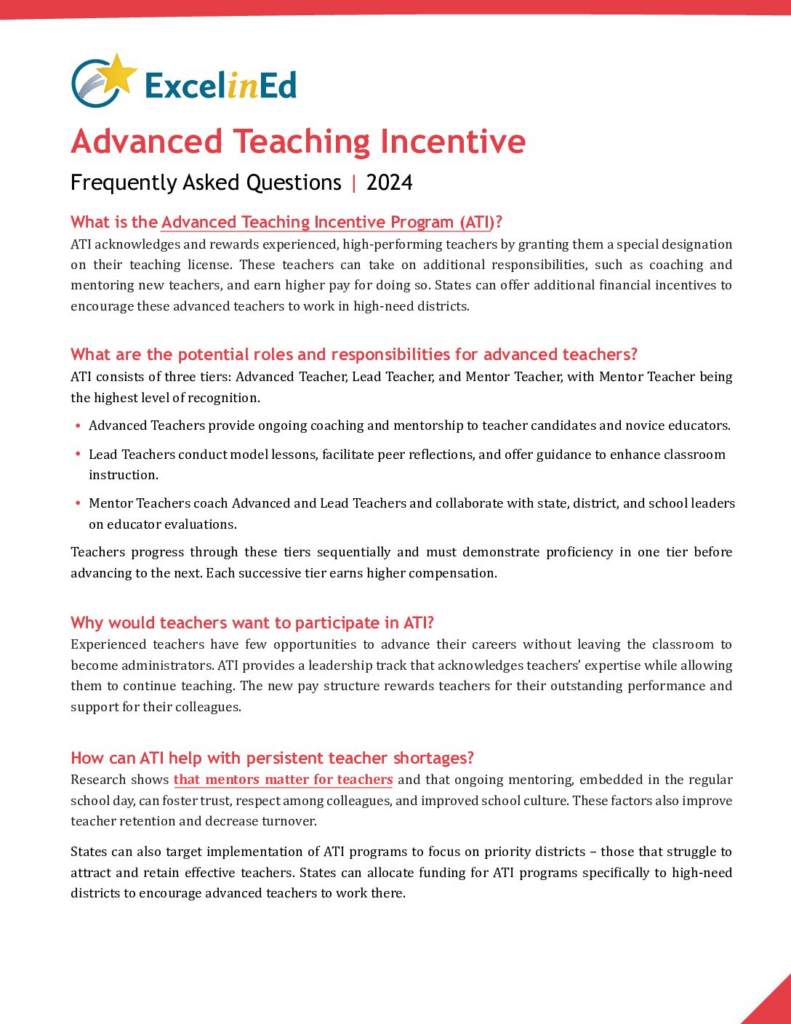
ATI acknowledges and rewards experienced, high-performing teachers by granting them a special designation on their teaching license. These teachers can take on additional responsibilities, such as coaching and mentoring new teachers, and earn higher pay for doing so. States can offer additional financial incentives to encourage these advanced teachers to work in high need districts.
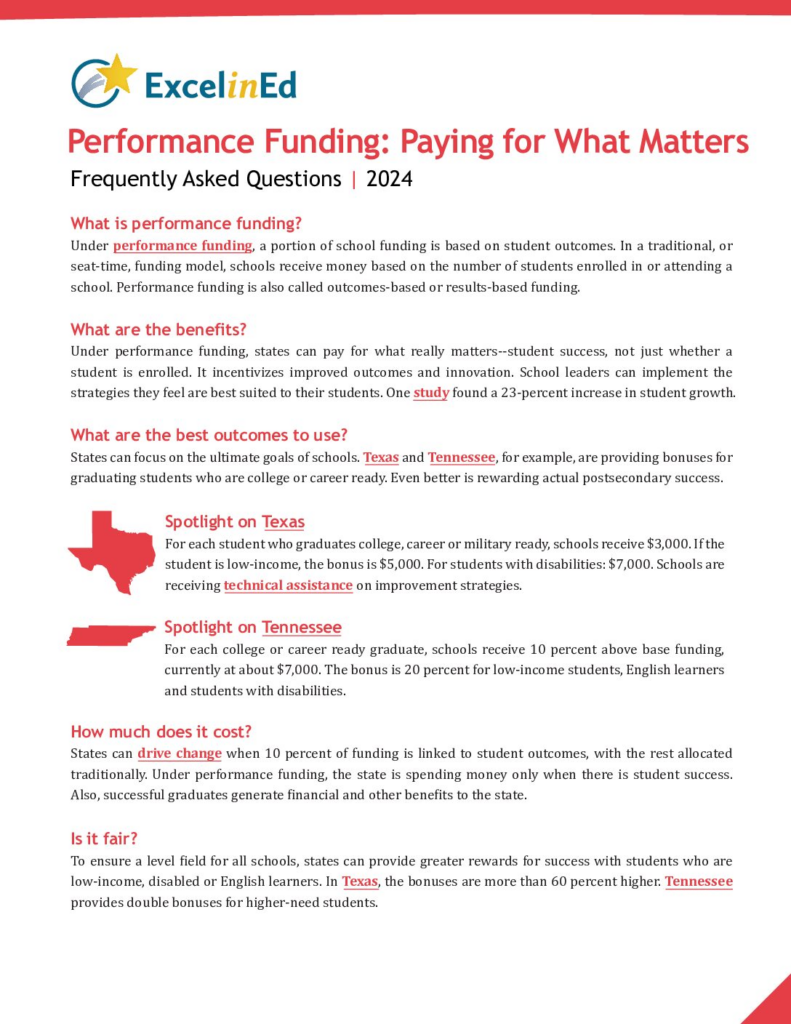
Under performance funding, a portion of school funding is based on student outcomes. In a traditional, or seat-time, funding model, schools receive money based on the number of students enrolled in or attending a school. Performance funding is also called outcomes-based or results-based funding.
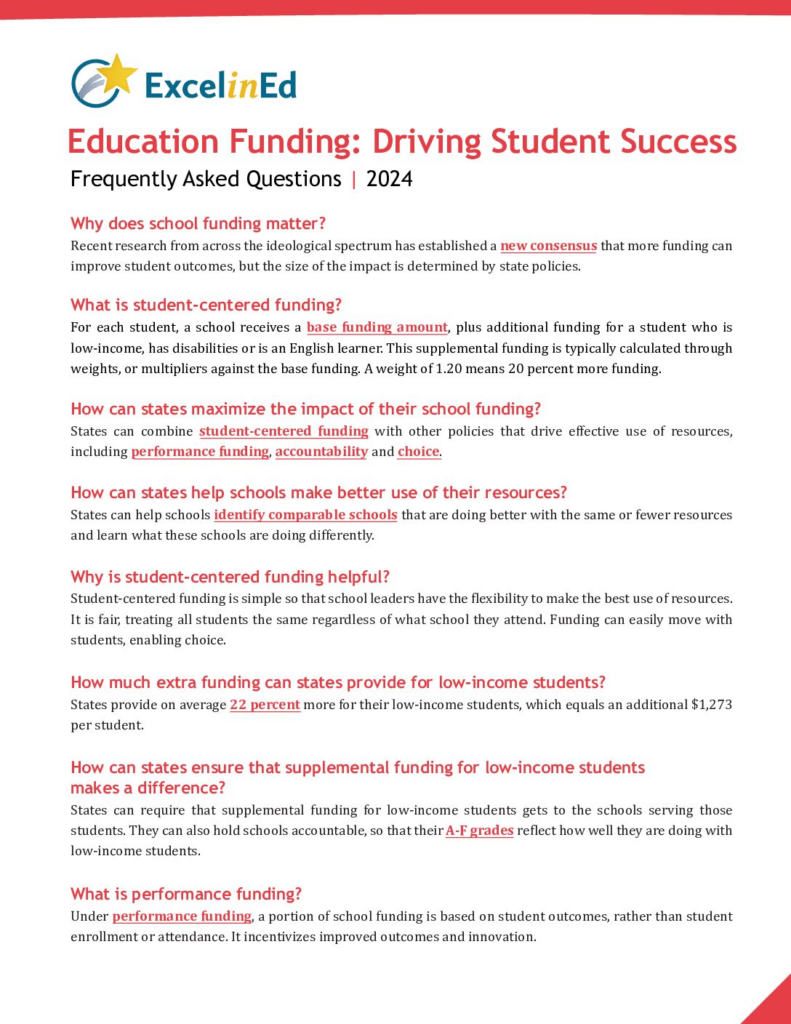
Recent research from across the ideological spectrum has established a new consensus that more funding can improve student outcomes, but the size of the impact is determined by state policies.