Abby Burrola is an Associate Director of Education Policy at ExcelinEd.


In recent years, tuition rates at Florida’s private schools have risen, mirroring trends seen across various sectors of the economy. Critics of school choice programs have suggested that the state’s embrace of universal school choice is to blame for these tuition increases. However, a closer look at the data reveals that this narrative doesn’t hold up under scrutiny.
ExcelinEd analyzed private school tuition trends and found that, by and large, tuition rates in Florida have tracked closely with inflation rather than being directly caused by the expansion of school choice programs.

This breakdown shows how the average private school tuition rate has closely mirrored fluctuations in inflation. The gap between tuition changes and inflation changes has actually gotten closer in recent years, while the rate of Florida students participating in private school choice programs has rapidly risen over the same time period. This would suggest that market forces—more families having a way to afford and then enroll in private schools of their choosing—have actually helped private school tuition remain affordable.
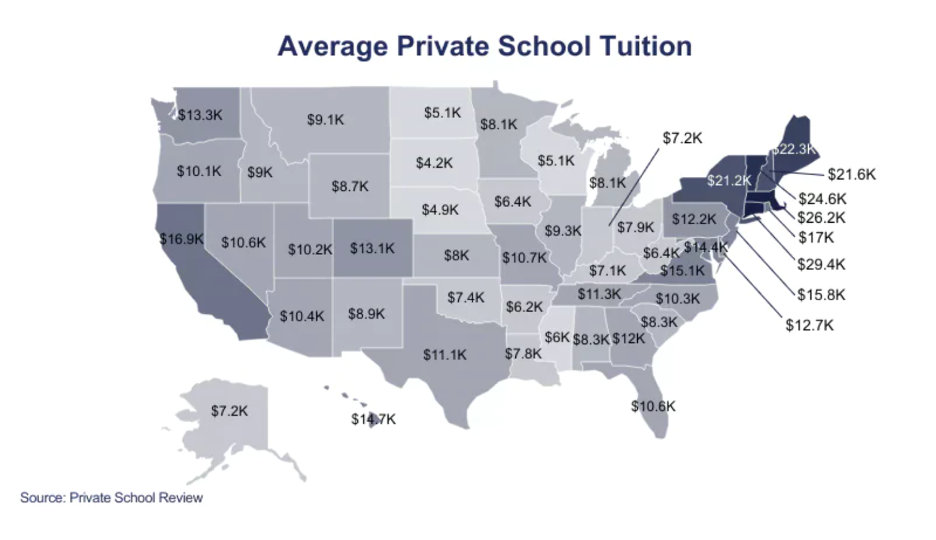
According to Education Data Initiative, when compared to other states, Florida ranks in the middle of the pack for private school tuition costs. As Florida has been an early adopter of private school choice programs, we would expect to see Florida’s private school rates higher than most states if choice did cause tuition hikes. That is not the case.
Like the cost of many goods and services, private school tuition has increased more sharply in the past three years than during the prior decade. While tuition increases can’t be attributed to a single cause, a combination of factors provides a clearer picture of what’s driving this trend.

Inflation, as measured by the Consumer Price Index (CPI), has been elevated since 2021. Significant federal spending during this period contributed to rising costs for goods and services, and private schools, as both consumers and providers, have felt these pressures acutely. An important response from private schools has been the need to raise teacher salaries to keep up with inflation, a significant portion of private schools’ budgets. From purchasing educational materials to managing facility expenses, the rising cost of doing business has forced schools to adjust tuition rates.
Private schools are sensitive to the economic realities of the families they serve. This creates a natural limit on how much schools can raise tuition without risking enrollment declines. Far from creating runaway tuition, Florida’s school choice programs empower families to access private schools while maintaining a balanced and competitive market. Rising costs, coupled with elevated inflation, have required schools to increase tuition to maintain their expected level of service. Importantly, private schools remain highly responsive to market forces; if tuition rises too quickly, families may choose other options, which keeps tuition in check over the long term. More families now can exercise choice, and that may mean selecting a different private school down the road that’s a better option, including financially.
It’s also common for private schools to offer students financial aid supported through school donations. State scholarships typically cover only a portion of tuition costs, and the difference may be made up by school-specific scholarships, with families paying the rest of the difference out of pocket. Household income did not keep up with inflation during the pandemic, meaning families were even more squeezed once state-funded and school-funded scholarships were exhausted. This gave schools even less ability to raise tuition because they knew parents couldn’t afford to pay the increase.
Calls to regulate private school tuition in Florida risk unintended consequences. Limiting tuition flexibility could shrink the supply of private schools and undermine the very educational opportunities that families increasingly demand.
In a survey experiment of private schools across the country, researchers found that 77% of the surveyed private schools were not likely to participate in a voucher program if it required the schools to accept a $6,000 voucher to cover the entire tuition cost. This lack of willingness to participate in a tuition-capped program would indicate the likelihood that tuition regulation would severely limit private school options for families. Even if schools opted to participate with this requirement, they would face financial constraints and might be forced to cut essential programs, reduce teacher salaries, or compromise on the quality of education—all of which would negatively impact students. Private schools are already operating on thin budgets compared to the state’s public schools, further stressing schools with artificial tuition caps would negatively affect students and schools.
Tuition regulation would be counterproductive to a robust private school market, harming families’ options. Fortunately, we see in the year-by-year comparison of Florida’s average private school tuition to inflation that the gap between those two data points grows smaller in more recent years, something that has occurred in other states with school choice policies.
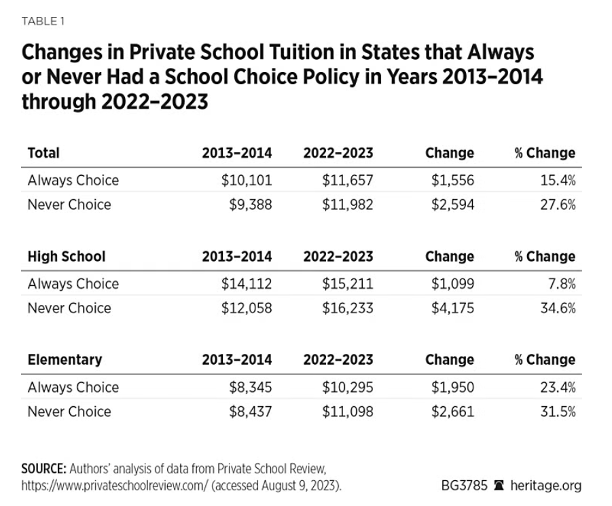
According to the Heritage Foundation, data from the past decade demonstrate that states that adopted school choice policies, on average, had lower tuition inflation compared to states that did not have private school choice programs. For states with school choice, after the adoption of school choice, inflation-adjusted tuition rates decreased. When it comes to elementary and high school tuition, school choice significantly reduced the former and had no significant impact on the latter. This analysis exclusively covered school choice programs with limited eligibility. More remains to be learned about the impacts of universal eligibility as these programs mature, but Florida’s experience suggests other factors are more closely associated with tuition growth.
To best support families, policymakers can focus on fostering a robust and competitive education marketplace where private school tuition rates adjust on their own without needless and potentially harmful tuition regulation policies. By ensuring families have diverse school options, Florida can maintain a dynamic system that balances affordability, access and quality.
Florida’s expansion of school choice in 2023, which made scholarships available to families of all income levels, has coincided with this period of tuition increases largely matching inflation patterns. However, the timing does not equate to causation. Tuition increases occurred across virtually all private schools in Florida, including those that do not accept state scholarships. This indicates that factors like inflation and market dynamics—not school choice—are driving the trend. Now that more families can access private school education, this introduces more competition among private schools, which means more incentive to keep a tight rein on tuition rates.
The rise in private school tuition is a multifaceted issue tied to broader economic trends rather than the expansion of private school choice. Florida’s universal school choice programs have empowered families without distorting the market.
Regulating private school tuition could shrink the supply of private schools that are increasingly in demand by families and force schools to make decisions that directly impact teaching and learning.
By understanding the real drivers of tuition increases, we can reject false narratives and focus on policies that preserve and expand access to high-quality education for all students.
